Wednesday, July 24, 2019

PSYCHOLOGY OF TEACHING AND LEARNING ::LEARNING & THEORIES OF LEARNING

Learning is a continuous process. In recent times, researchers have explored that we start learning from the day we are conceived as a life form in our mother’s womb.  Man has been learning from nature; by watching the world outside and inside him, from what others say or do. We also learn by doing. This is also accumulated as knowledge. Every subject that we learn has an internal discipline. So learning of each subject demands application and order.

In my April blog, we have discussed about learning and factors influencing learning and transfer of learning. Today through this blog I am trying to throw light on the principles of learning and social learning.

Learning is the desired change or modification of behaviour attained through experience and environment.

Principles of learning:


Learning may be formal or informal in the school or out of the school. General principles include:

1. Learning is universal. All living beings learn.

2. Learning is a continuous process. It goes from womb to tomb. We keep learning from the day we are in the womb of our mother to the day we die.

3. Learning is directly proportional to development. Without learning development does not take place in the individual.

4. Learning makes an individual dynamic and flexible in all life situations than static or rigid. Learning opens the closed walls of our brains and help in finding path in any situation.

5. Most of the learning is purposive. We learn to attain fewer goals on daily basis, finally for our all round development. It is to get specific result and fulfil the goals.

6. Learning takes place both at conscious and unconscious level.

7. Learning is possible at adequate level of physical and mental maturity.

8. It prepares an individual to face new challenges and use the experience of one situation for other complexities of life. Learning is transferable. Learning modifies one’s behaviour cognitively, affectively and in psychomotor aspect. Its scope is very wide.

9. Learning is influenced by intelligence of the individual and the kind of teaching or training given to him/her.


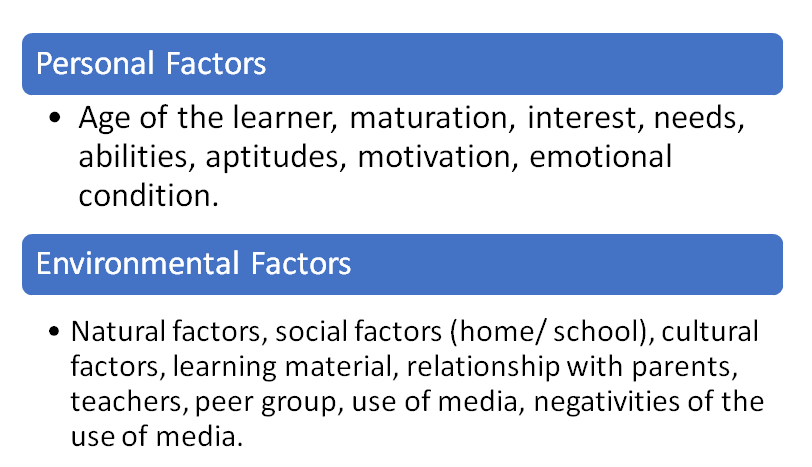
Factors of learning:

Understanding and managing the different influencing conditions both personally and environmentally is the crucial aspect in the classroom management. 


Operant conditioning theory:


Operant conditioning (sometimes referred to as instrumental conditioning) is a method of learning that occurs through rewards and punishments for behaviour. Through operant conditioning, an association is made between a behaviour and a consequence of that behaviour.

For example, when a lab rat presses a green button, he receives a food pellet as a reward, but when he presses the red button he receives a mild electric shock. As a result, he learns to press the green button but avoid the red button.


His theory was heavily influenced by the work of psychologist Edward Thorndike, who had proposed what he called the law of effect. According to this principle, actions that are followed by desirable outcomes are more likely to be repeated while those followed by undesirable outcomes are less likely to be repeated.

Let’s deal this with two scenarios:
Scene 1- When a student is praised for her handwriting, the student would try to make it better and beautiful. Operant conditioning relies on a fairly simple premise - actions that are followed by reinforcement will be strengthened and more likely to occur again in the future.

Scene 2- After the teacher asked a question, the students reply all together in a group. The teacher does not like this behaviour and asks the children to raise their hands, if they know the answer.

Conversely, actions that result in punishment or undesirable consequences will be weakened and less likely to occur again in the future.


Types of Behaviour by Skinner:


Components of Operant Conditioning Theory:

 Let’s learn about the concepts.
Reinforcement in Operant conditioning theory can be positive reinforcement or negative reinforcement.

Positive reinforcement: They are favourable events or outcomes that are presented after the behaviour. Strengthening the behaviour by the addition of something, could be praise or a direct reward. For example: Teacher giving a star sticker to a student in the class.
Negative reinforcement: It involves the removal of an unfavourable event or outcome after the display of a behaviour. For example: Students are screaming in the class and the teacher announces that she will give the star sticker to the students who are disciplined.
In both of these cases of reinforcement, the behaviour increases.

Punishment in operant conditioning theory can be positive punishment or negative punishment.
Positive punishment: It is referred to as punishment by application. It presents an unfavourable event or outcome in order to weaken the response it follows. For example: Spanking for misbehaviour is an example of punishment by application.
Negative punishment: It is known as punishment by removal, occurs when a favourable event or outcome is removed after a behaviour occurs. For example: Taking away a child's sticker following misbehaviour is an example of negative punishment.
In both of these cases of punishment, the behaviour decreases.


Operant conditioning is something we recognize in our own life on a daily basis, whether as a parent or a teacher or as an individual.


Social Learning Theory:


Social learning theory is also known as imitation learning theory or the observational theory. It is a bridge between behaviourist and cognitive learning theories because it encompasses attention, memory and motivation. It was developed by educational psychologist Albert Bandura. It is considered as a highly influential learning theory.

Bandura’s social learning theory points that the people learn from one another, via observation, imitation and modelling. According to him, human behaviour is learned observationally through modelling from observing others, an individual understand the new forms of behaviour; on the later occasions the learnt code and information serves as a guide for action.

Social learning theory explains human behaviour in terms of continuous reciprocal interaction between cognitive, behavioural and environmental influences. The theory identified several factors that determine whether observing a model will affect behavioural or cognitive change.

 These factors include:
1. Learner’s developmental status,
2. The perceived prestige,
3. Competence of the model,
4. The consequences received by the model,
5. The relevance of the model’s behaviours,
6. Consequences to the learner’s goals,
7. The learner’s self efficacy:  Self efficacy is the learner’s belief in his or her ability to perform like the modelled behaviour. It played an important role in later developments of the theory. 


Observational learning explains the nature of children to learn behaviours by watching the behaviour of the people around them, and eventually, imitating them. With the "Bobo Doll" experiment, Bandura included an adult who is tasked to act aggressively toward a Bobo Doll while the children observe him. Later, Bandura let the children play inside a room with the Bobo Doll. He affirmed that these children imitated the aggressive behaviour toward the doll, which they had observed earlier. After his studies, Bandura was able to determine 3 basic models of observational learning which included a live model, a verbal instruction model and a symbolic model. A Live Model, which includes an actual person performing a behaviour. A Verbal Instruction Model, which involves telling of details and descriptions of a behaviour. A Symbolic Model, which includes either a real or fictional character demonstrating the behaviour via movies, books, television, radio, online media and other media sources.

Bandura believed that learning doesn’t bring change in the behaviour of an individual. The state of mind is crucial to learning. In this concept, Bandura stated that not only external reinforcement or factors can affect learning and behaviour. There is also what he called intrinsic reinforcement, which is in a form of internal reward or a better feeling after performing the behaviour (e.g. sense of completion, confidence, satisfaction, etc.)

Conditions of effective modelling:
The Modelling Process developed by Bandura helps us understand that not all observed behaviours could be learned effectively, nor learning can necessarily result to behavioural changes. The following are the steps included in order for us to determine whether social learning is successful or not:

Attention: Attention to a particular behaviour is the first step. Various factors such as distinctiveness, affective valence, prevalence, complexity, functional value increase or decrease the amount of attention paid. Individual’s characteristics like sensory capacities, arousal level, perceptual set and past reinforcement affect attention.

Retention: Behaviours caught in the attention of the observer has to be retained in the memory for it to get absorbed into the system of the observer. Memory retention is facilitated by symbolic coding, mental images, cognitive organization, symbolic rehearsal and motor rehearsal. 

Reproduction: After attending the information and later retaining it, this step requires demonstration of the behaviour. Perfection in reproduction of the behaviour, mannerism can be attained by reproduction of the observed behaviour.

Motivation: Feeling a sense of motivation. Motivation to repeat the behaviour is what we need in order to keep on performing it. This is where reinforcement and punishment come in. For example: We can reward a student after observing his/her demonstration and proper behaviour, and can punish on displaying it inappropriately. Having a good reason to imitate includes promised, imagined and vicarious incentives.


Classical Conditioning Theory:


This theory is also known as Conditioned response theory, Respondent conditioning theory and Pavlovian conditioning. Conditioning means modification of a natural response. It is the acquisition of a new stimulus-response relationship. This theory was developed by a Russian physiologist Ivan Petrovich Pavlov in 1904. He got the Nobel Prize on his research ‘Digestive system of dogs’ in the same year. 


Pavlov’s Experiment:
Pavlov conducted a number of experiments on dogs to study how the stimuli and responses are associated.
Classical conditioning is a type of learning, where a neutral stimulus is paired with a stimulus that elicits an emotional or physiological response. After repeated pairing, the previously neutral stimulus alone will elicit a similar response.   


Principles of Classical Conditioning: 

Let's take a closer look at five key principles of classical conditioning:

Acquisition: Acquisition is the initial stage of learning when a response is first established and gradually strengthened. During the acquisition phase of classical conditioning, a neutral stimulus is repeatedly paired with an unconditioned stimulus. After an association is made, the subject will begin to emit a behaviour in response to the previously neutral stimulus, which is now known as a conditioned stimulus. It is at this point that we can say that the response has been acquired. If we take a look at the experiment, dog was conditioned to salivate in response to the sound of a bell. Pavlov repeatedly paired the presentation of food with the sound of the bell. We can observe that the response was acquired since the dog began to salivate in hearing the bell sound.

Extinction: It is when the occurrences of a conditioned response decreases or disappears. In classical conditioning, this happens when a conditioned stimulus is no longer paired with an unconditioned stimulus. The unconditioned stimulus (the smell of food) were no longer paired with the conditioned stimulus (the bell sound), eventually the conditioned response (salivation) would disappear. This is known as extinction.


Spontaneous recovery: Spontaneous recovery is the reappearance of the conditioned response after a rest period. For example: When the dog was brought back to the laboratory after some rest, salivation occurred after hearing the bell.

Generalisation: Stimulus generalization is the tendency for the conditioned stimulus to evoke similar responses after the response has been conditioned. For example: The dog responded to almost any sound roughly similar to the ringing of the bell. 
Classical Conditioning of a Fear Response:
One of the most famous examples of classical conditioning was John B. Watson's experiment in which a fear response was conditioned in a boy known as Little Albert. The child initially showed no fear of a white rat, but after the rat was paired repeatedly with loud, scary sounds, the child would cry when the rat was present. The child's fear also generalized to other fuzzy white objects.

Differentiation: Discrimination or differentiation is the ability to differentiate between a conditioned stimulus and other stimuli that have not been paired with an unconditioned stimulus. For example: If two sounds are sufficiently distinguishable the dog responded only to one stimulus- the bell.


Educational Implications:
A. Bad habits can be broken by de-conditioning. Many fears, phobias and prejudices are a result of conditioning.
B. Principles of classical conditioning can be utilized to create good habits in children such as punctuality, discipline and respecting elders.
C. Repetition and habit formation is to be strengthened in the process of learning.
D. Establishing a connection between stimulus and response is an important objective of education. Classical conditioning theory established the theory that motivation is basic to learning.
E. Children should be awarded immediately, when they do well. The delay of awarding causes no effect.
F. Most of our learning is based upon conditioning, so teachers should develop the good reading habits through conditioning.

We live in a generation ahead than in what we have grown. Children are the future ‘Ambassadors of peace’ and ‘Leaders of the world’. We live in a world where the food we are eating is different from what we had as kids. Different conditions of existence are causing different issues in the growth, development and maturation of the child. Explosion of knowledge, made parents expect more from the children.

 To attend the needs of the child it’s important that the parents and teachers work as partners rather than leaving the education as the responsibility of the teachers. Teachers must be trained properly and must be aware of the strategies. Every child is unique and different and has different ways and procedures of learning. We need to be patient about it and use different ways to find out the processes that brings change in an individual. School management and the curriculum makers must understand that, it is very important for the child to settle and must understand that things need time and plan procedures as per the interest of each child on a multi planned set up. So that all things are covered and teacher gets time to plan strategies using the learning theories.

Teachers must apply classical conditioning in the class by creating a positive classroom environment to help students overcome anxiety or fear. Pairing an anxiety-provoking situation, such as performing in front of a group, with pleasant surroundings helps the student learn new associations. Instead of feeling anxious and tense in these situations, the child will learn to stay relaxed and calm. These theories help a teacher in managing the class as a whole. Children in general and we as individuals, learn things by observing models, parents, teachers, peers, motion pictures, TV artists, bosses, and others. Many patterns of behaviour are learned by watching the behaviours of others and observing its consequences for them. For effective teaching teacher should arrange effective contingencies of reinforcement.
Operant conditioning is a behaviour therapy technique that shape students behaviour. For this teacher should admit positive contingencies like praise, encouragement etc. for learning. One should not admit negative contingencies. Example: punishment leading to escape stimulation.

Complex behaviour exists in form of a chain of small behaviour. Control is required for such kind of behaviour. This extended form of learning is shaping technique. Teachers and parents should know how to motivate the children to learn.

As teachers we should be versatile with various strategies that can enhance effective participation of the students in the teaching-learning activities. The teachers should be familiar with these theories and apply it to teaching-learning activities where ever applicable. 


A teacher’s job is the most important of all as they play multiple roles at school and are the architects designing the future of the nation and world as whole. Parents of today’s world must understand this and appreciate the work of schools and must work parallelly with the teachers for the holistic development of a child.


Tuesday, June 18, 2019

PSYCHOLOGY OF TEACHING AND LEARNING :: NEEDS, MOTIVATION & MASLOW's HIERARCHY THEORY OF NEEDS.


Needs are the necessities that an individual have throughout his or her life. If the needs are satisfied, individuals feel motivated. Every individual have many needs, it can be materialistic or quantity based or can be qualitative in nature. Today through this blog, I am going to help my audiences understand the various needs of an individual and thrown light on the ‘Maslow’s Hierarchy Theory of Needs’. We are going to discuss how completion of the needs leads to motivation. 

A motivation can be verbal from other individual or can be by fulfilment of the needs he or she have. Motivation gives an individual the power of hundreds of elephants to tackle all the challenges life throws at you.

Motivation has been studied by psychologists since the early 1970’s. Any action of human beings needs motivation. A motivated person does his or her activity properly. When we talk about the children, who are the future of our country or say the ambassadors of world peace, they need motivation for learning as well. Even we need motivation at times to finish a task or to learn something new. This motivation is the central factor in the process of learning. It brings out the interest of an individual to learn. Motivation is the crucial factor in classroom management; it affects learning and the behaviour of students.

The term motivation originated from a Latin word motum, which means motion. Motivation arouses the interest in learning and doing something. By doing something unusual and learning continuously we become more wise and humble in our life. Motivation is the inner state of arousal which energises the individual to act on the goal attainment. Motivation works at the level of subconscious mind and help individual adapt to things faster.

To further understand the concept of motivation let me quote an example of two situations.
Situation 1: A person surrounded with negativities.
Situation 2: A person supported by people with positivity.

Let’s discuss both the situations:
 In situation 1, the person is surrounded with negativities. People who are too judgemental. People who de-motivates the individual, who back bite him and finally causes him to feel insecure. What do you feel, isn’t motivation an important need that affects an individual so much? Consider situation 2, the person is supported by people with positivity. People who are positive and have good attitude towards things will help each other and build each other. Finally motivating and strengthening each other and finally leading to a much better society. We need to understand the fact that we want leaders for our growing economy, we need leaders who will bring world peace and join the nations. Every individual and his or her actions and behaviour affects the society, nation, world and the universe. We all are a part and parcel of it.

Now imagine a situation where we are talking about children in this context, tiny little creatures taking so much of negativity. They cannot even express the pain due to lack of words and maturity at that age. It is important to understand that the first contact of the child i.e. the parents, grandparents, relatives and maids at home and then the second contact of the child i.e. the teachers, principal, peers etc. Everyone matters in the process of growth of an individual and children as whole. Children are like sponges. Whatever you speak before them, they just absorb. 

Maslow (1971) argued that a humanistic educational approach would develop people who are “stronger, healthier, and would take their own lives into their hands to a greater extent. With increased personal responsibility for one’s personal life, and with a rational set of values to guide one’s choosing, people would begin to actively change the society in which they lived”.

In today’s scenario we are complicating the situation with extra case towards the children. It is true that motivation, love and affection are important but with that over flooding the needs, will lead to a difficult situation. Parents should keep a proper gateway to the needs that are being provided to a child. Every human has to struggle finally in his or her life to achieve whatever he or she wants. We are making their life so easy and simple thinking its care and concern. But during harsh time, when they face a problem or a challenge they are becoming handicapped literally and giving up or ending their lives.

 Think about the same child, who fought for 9 months in the womb of his or her mother just gave up...….

Giving up is very easy in life, what is to be taught is to find ways to fight back and to stand strong; these are the life skills which need to be taught to the children. It has a greater impact when taught by parents than the teachers. To teach the children that we need to be like water. Flexible like water, attaining the shape of a container. Teach the child to adapt to whatever situation lies before. Being a parent or teacher the best advice we can give to a child is, move ahead I am with you!! What more does he or she needs than motivation.

 On the same contrary correcting the child is also very important but positively without comparing the child, without being too judgemental recollecting the odds of past. Every child is unique, different and special. Once we understand this fact, that makes the child unique and special from others, handling the child becomes very easy. We can make a child do anything and everything, the only point is to find the unique factor and the proper direction to be given.


Abraham Maslow (1954) had developed a hierarchical order of needs from physiological to self-actualization needs. Maslow’s theory is also known as ‘Self-actualization Theory’.

Maslow classified the needs starting from the basic survival or lower order needs to higher order needs. They are Physiological needs, Safety needs, Love or belongingness needs, Esteem needs, Cognitive needs, Aesthetic needs and Self-actualization needs. Maslow says that these needs can be arranged in a hierarchy. A man is never satisfied by all his needs. If one need is satisfied another need will arise and it is a human tendency.

I even want my audiences to understand the fact that we cannot satisfy any individual 100%. Don’t stress so much upon yourself, rather do things that make you happy at first place or fulfil your needs and make you feel motivated.

Going back to Maslow’s Theory:
Maintenance needs: The first four needs such as physiological needs, safety needs, love or belongingness needs and esteem needs are considered to be maintenance needs or motives. These needs are strong and are recurring. They become very strong, when they are denied. These needs basically are granted or denied by external factors.
Growth needs: The other three needs cognitive, aesthetic need and self-actualization needs are considered to be growth needs and they spring and bloom from within. They are mild and continuing. They grow strong if fulfilled. With respect to children, maintenance needs should be satisfied among students when they are educated. Growth needs should be made realized of by teachers to students for their benefit and future goal accomplishment. 


In the hierarchy if the first need is satisfied the next becomes dominant and reaches self-actualization need, which is the highest level of functioning. Let’s discuss each need briefly.

1. Physiological Needs: These are the most potent of all and are the basic needs required for the existence of an individual. These needs are also called as biological needs. Need for food, water, oxygen, rest, sleep, elimination of wastes from body is fundamental for the survival of the individual. 


2. Safety Needs: Once the physiological needs are granted, these needs become dominant. It includes security and order. E.g. when the child goes to the school for the first time, he/she weeps and cries of losing the safety.

3. Love or Belongingness Needs: These needs emphasize the gregarious nature of human. Everybody has a desire to love and to be loved. It helps in motivating the individual and maintains a pleasant and happy relationship with others.

4. Esteem Needs: It means prestige, social status, reputation, self-esteem, self-respect and self-regard. Every individual wants to look high in the eyes of the others. One feels hurt, if his/her self-respect is injured. Esteem need also include an individual’s achievement. Every individual manifests the need for achievement. The achievement of an individual depends upon his talent and the environment.

When a child enters a school, the most important thing for him/her is to overcome the emotional pain which he/she experiences. Providing him/her with food and safety will satisfy him/her partially. Love, care and belongingness of a very higher order which can replace the emotional pain that the child is experiencing can do wonders..... Curriculum makers need to give that extra space to child to settle first. Once the child becomes teacher’s pet, to mould the child is not difficult. This logic applies to all the schools, colleges, universities and professionals as well. Time can settle things in a better manner than unnecessary hush and rush.

5. Cognitive Needs: It includes knowledge, understanding, curiosity, exploration, need for meaning and predictability.

6. Aesthetic Needs: Aesthetic needs mean appreciation of beauty and order of things or arrangement of things appropriately. Every one derives pleasure in appreciation of beauty, music and nature. E.g. poets.

7. Self-actualization Needs: Self actualization means maximum development of an individual, whatever he or she is capable of. It means to fulfil one individual’s nature in all its aspects. A self-actualizer is free from all the restrains of a society and wants to attain perfection in all the aspects of the life. It is the highest need. For Maslow, a person is always 'becoming' and never remains static in these terms. It’s actually a dynamic process.  In self-actualization, a person comes to find a meaning to life that is important to them. In this stage they try to challenge the reason for their existence. As each individual is unique, the motivation for self-actualization leads people in different directions (Kenrick et al., 2010). For some people self-actualization can be achieved through creating works of art or literature, for others through sport, in the classroom situation, or within a corporate setting.


8. Transcendence Needs: When an individual helps others to reach self-actualization. Person is so much motivated by values which transcends beyond the personal self. E.g. service to others.


Every individual is capable and has the desire to move up the hierarchy towards a level of self-actualization. Unfortunately, progress is often disrupted by a failure to meet lower level needs. Life experiences, challenges and loss, may cause a person to fluctuate between the levels of the hierarchy. Therefore, not everyone will move through the hierarchy in a one-directional manner but may move back and forth between the different types of needs.

Before a student's cognitive needs can be met, they must first fulfil their basic physiological needs. E.g. a hungry student will find it difficult to focus on learning. Students need to feel emotionally and physically safe and accepted within the classroom to progress and reach their full potential. For effective learning all these needs are to be satisfied. It is the responsibility of the teachers to check with the students whether all these needs are satisfied for the smooth running of the class.


Students must be shown that they are valued and respected in the classroom, and the teacher should create a supportive environment. Students with a low self-esteem will not progress academically at an optimum rate until their self-esteem is strengthened. Earlier there were fewer numbers of schools; now a day’s every street has one. Selecting proper school that really caters the needs of the child is mandatory, it is not important whether it is a well equipped branded school or a normal school. In this hi-tech generation, parents are so busy with their jobs and lives that they are just sending the child to school without proper understanding of what are his or her needs. 

Parents have huge expectations from the tiny creatures, who are just settling. I have heard stories from my personal involvement with parents saying, “As a child, I and my husband did wonders, don’t know why my child is so?” Growth, development and maturity happen at different levels for each individual. Today a slow learner or a back bencher or a weak student can be tomorrow’s brilliant scientist, world leader or can be a great human. We should stop judging and start accepting the uniqueness. The same thing applies for individuals around the world. 

Love humans without conditions or judgement. The more you judge people; your mind will start accepting the negativities and slowly the subconscious mind will make a wrong picture in your mind which can’t be corrected.
It is very easy to speak lies about someone and imagine very hard for that someone to prove himself back. So make life easy for others. Bloom with positivity!!
May God bless you all!
Thank You,
Srividya Gurugubilly.

Wednesday, May 15, 2019

PSYCHOLOGY OF TEACHING AND LEARNING :: MEMORY AND EFFECTIVE METHODS OF REMEMBERING.


Today, through this blog of mine.... I am going to discuss about the most important topic 'Memory'. Many of us tend to forget matters related to daily life, related to what we just studied and as most of us complain..... Husbands forgetting the important dates!!

We have an important household formula of eating almonds to improve the memory. Indeed almonds are good for health but memory as a phenomenon is entirely dependent on the individual and his or her ability to manage his or her brain connections. 

Hope by the end of this topic, you will have a better understanding of the mechanism of controlling and training your brain. This part of educational psychology has huge importance for teachers and parents. As the saying goes... First impression is the best impression!! It is the first mark made on the brain that helps the child to remember the best and finally helps in attaining a stage where the teachers' and parents' work gets simpler.


Things we learn are stored in our brain. This process is technically called as memory. Learning and remembering are complementary processes. Remembering and forgetting are opposite sides of the same coin. Both the terms memory and remembering carry the same meaning. Sternberg defined memory as the means to draw past experiences in order to assess the information at the present. The complete process of structuring and processing the information involved in the storage and retrieval of such information can be defined as memory.

According to Woodworth, four main elements are involved in memory. They are: learning, retention, recall and recognition. Memory is the mental capacity of an individual to store the information and recall or recognise that information. 


Memory is a store house. It stores information. This information is recollected. Memory in general is an ability to remember things that happened a short or long time ago. So, our mind has the power of retaining and reproducing the information.

Memory processes limitless amount of information every day, and information is stored in different forms like meaning, sounds and images. From storing the information to the final processing in order to produce a desired outcome, memory can be categorized into three stages.

1.       Encoding,
2.      Storage and
3.      Retrieval.


Encoding

Encoding is the first stage of memory. As the term suggests, this is the stage of memory which accumulates all the information from the surrounding and encodes or stores it in our brain. The information we intake from the world around us is processed in three different forms.
·         Visual (picture)
·         Acoustic (sound)
·         Semantic (meaning)

In simple words, these different forms are how we take in the information. We either consume information as a picture, a sound, or we make it meaningful. These three different forms are termed as visual, acoustic and semantic accordingly. 


Encoding can also be defined as the process used to remember the information. We retrieve information in the same form we take it in because of this process. The more deeply we encode the information, the better we are able to recall it. For instance, consider remembering a telephone number say 9xxxxxx333. You are seeing it, means its visual or structural coding . If you’re repeating the number to yourself verbally in order to remember it, that’s acoustic or phonetic coding. Likewise, if you perceive that the last three numbers of the phone number are same, all 3’s, you are giving meaning to it. We are actually connecting small pieces of data to memorize it easily and meaningfully. Visual coding is shallow process compared to acoustic and semantic coding. Semantic coding is a deeper coding process and it helps in strong encoding of data. This is the reason while curriculum designing the topics are designed in a connected way so that the individual can learn by connecting things and can memorize it easily. Every child is different and so the memory levels... When a concept is introduced to a child, it needs to be done in a way that things are more easier to learn, understand and to memorize it for future retrieval. 

All three forms of encoding takes place so that you can remember that particular number. It has been found out that acoustic coding is the major form of encoding in Short Term Memory. Likewise, the major encoding system for the Long Term Memory seems to be semantic, with meaning. But it’s not just limited to that, and can be done in visual and acoustic forms too.

Storage

This stage deals with nature of the memory where the information is stored, time duration of the memory, the amount of information that can be stored, and type of memory. The manner in which information is stored directly affects the way in which information is retrieved. Information is stored in two main parts of memory.
Short Term Memory (STM)
Long Term Memory (LTM)

Miller stated in 1956 that most adults are capable of storing 5 to 9 items in their STM, short term memory, and he called it the magic number 7 (plus or minus 2). According to findings of Miller, there is limited number of slots in Short Term Memory; however, he didn’t specify the amount of information that can be stored in each memory slots. This gives the idea that more than one information can be stored together if information can be related and chunked, one upon another. Total capacity of Short Term memory is said to be around 0 – 30 seconds. 


Long Term Memory, however, is a whole different ball game when it comes to memory. Its capacity is said to be unlimited and the information stored can last as long as whole life time. For example, we might remember the colour of someone’s dress only for a while if it’s stored in short term memory. However, we remember that the sun rises from the east, and we will probably remember it for the rest of our lives, which is the information stored in long term memory. This memory is due to the continuous experiences that are added to this point based on focus of an individual and daily observation in practical sense. This is one of the reasons to include practical observations in the form of experiments and field trip; so that the actual idea is established in the minds of children. 


Retrieval

As the term suggests, retrieval refers to retrieving information out of our memory storage. Failure to retrieve information is often understood as not being able to remember or recall the particular information. Trying to retrieve information from our memory makes the differences between STM and LTM pretty apparent.
STM is both stored and retrieved in a sequential manner. For example, let’s say a subject is given a phone number to remember and then asked the second last number on the list. The person goes through the number from the start to retrieve the required information.

LTM is both stored and retrieved by association. Remembering a certain action might lead to retrieval of information about some other actions. For instance, you lost your phone, travelling the same road you were walking the day before might lead you to retrieve information about the things you had seen the day before. Finally relate it to the missing phone.

Memory organization is one of the ways to increase your ability to retrieve memory. Information can be organized alphabetically, by time, by size, or by any other means you deem fit. This will help you recall the information in a swift manner as you’ll be more comfortable with the manner in which you organized the information. Failure of any of these stages lead to failure in memory or in simple terms leads to forgetting things. 


Fact about our Brain:

Perhaps what is really amazing isn’t how much we forget, but how much we can remember. No one knows for sure how much information the human brain can hold, but most estimates agree that your memory can hold around 2.5 petabytes of information (that’s 2.5 million gigabytes). A digital video recorder with a capacity of 2.5 petabytes could hold 3 million hours of television programmes.


Forgetting!! Reasons why we forget.....


Information floods into your brain via your senses, and the most important information is held briefly in a very short-term zone called the sensory register. If you don’t pay any attention to this information it will almost immediately disappear through a process called decay. Decay is what happens when nerve cells stop firing in a certain pattern, and that pattern is lost.

If you are trying to remember a phone number, short term memory is where you hold it. Again, if you don’t make an effort or the information is not memorable, it will decay or simply be replaced by the next thing. In both this case and the previous one, you forget something because you never stored it as a memory.

In long term memory a memory is laid down in your brain as a more-or-less permanent trace. It seems likely that once a memory is laid down like this it lasts forever unless some physical damage actually destroys the nerve cells involved in the memory. But just because a memory is stored somewhere in your brain, it doesn’t mean you can remember it. If you can’t get hold of it, it means you’ve forgotten it, and there are lots of reasons why this could happen.

One reason is called interference. This is where other memories interfere with the one you are trying to remember. For instance, if you are trying to remember what you had for lunch two days ago, the memory of what you ate yesterday might interfere.

Decay and interference explain how forgetting might help us to survive. Decay means that our brains don’t store every single thing that happens. According to some studies it is estimated that, we only remember one out of every 100 things. This helps us to focus on things that are important or things which are prioritized by us, such as where to find shawarma in Hyderabad, location of the important documents or location of your phone.

Interference makes it hard to remember stuff, so by forgetting things we stop them from interfering with the important stuff. In other words, in order to have a good memory, you have to have a selective memory, and that means forgetting.


Techniques for effective memorization:

·         Practice improves methods of learning.
·         Concentration in learning is conducive for effective recall.
·         Interest in learning brings out memory too.

Methods of memorizing:


Recitation Method: It is the mental repetition of something, it is an active way of study and it not only saves time, but also ensures longer retention of the material learnt. In preschools recitation on a constant basis help all the children in the learning process. During the Vedic period, Guru used to recite the hymns and ask the shishyas to repeat to learn faster. This is also an important way to understand the intonation and pronunciation.

Spaced and un-spaced Method: Spaced method is one in which time intervals are given in the learning process. Un-spaced method is gone at one sitting, without any intervals. These two methods are used based on the maturity of the learner. Spaced method is considered advantageous than un-spaced. Since the individual comes back every time with freshness to learn.


Part and whole Method: In the part method, the learning material is divided into parts and memorised separately; where as in whole method, the material is learned from the beginning till end. Both have advantages and disadvantages. Whole method is more effective for short learning material. The combined method is also to be encouraged. Connecting each part to the other also increases the curiosity and there by enhances the focus and leads to good memory of an individual.

Rote and Intelligent Method: Learning and memorizing without understanding the content is rote or unintelligent method. Learning and memorizing with proper understanding and deep knowledge of the content is intelligent method. Intelligent method is more effective than rote learning.

Grouping and Rhythm Method: Memorization is carried away by rhythm or grouping. It is easier to memorise poetry than prose because of the rhythm involved.

Nevertheless to say, there are many topics where the children find it difficult to learn. So, as a parent or as a teacher; designing the learning process filled with lot of fun, games and activities make it not only easy for the children, rather it makes them more enthusiastic towards learning. Connecting it to daily life events makes it more memorable and so it gets easy to remember. Understanding the main essence of a topic is important. To make the learning process easy and interesting, we use a number of teaching aids. Teaching aids create visual and interactive experience for the students and help to present the information in a way that can help students learn and understand. Teaching involves more than simply sitting in the front of the classroom reciting information to the students in the class. These techniques also help in memory building.

In today's era of knowledge explosion, parents and teachers have huge expectations from the growing minds. It is not the mistake of the student or the parent or the teachers, if the child is unable to learn. Learning depends on many factors as we have seen in our previous blog. It is the responsibility which must be taken equally by everyone in the life of a child, including he or she himself or herself. Every child and every individual is different, unique and special. So the ways of learning also differs. Make the learning more activity and fun based for a better learning. The main idea is the right impact!!


Online Classes Guidelines

For students, this time of the year used to be all about the smell of freshly printed books, new classrooms, new bench mates, new school uni...