
In my April blog, we have discussed about learning and factors influencing
learning and transfer of learning. Today through this blog I am trying to throw
light on the principles of learning and social learning.
Learning is the desired change or modification of behaviour
attained through experience and environment.
Principles of learning:
Learning may be formal or informal in the school or out of the
school. General principles include:
1. Learning is universal. All living beings learn.
2. Learning is a continuous process. It goes from womb to tomb. We
keep learning from the day we are in the womb of our mother to the day we die.
3. Learning is directly proportional to development. Without
learning development does not take place in the individual.
4. Learning makes an individual dynamic and flexible in all life
situations than static or rigid. Learning opens the closed walls of our brains
and help in finding path in any situation.
5. Most of the learning is purposive. We learn to attain fewer
goals on daily basis, finally for our all round development. It is to get
specific result and fulfil the goals.
6. Learning takes place both at conscious and unconscious level.
7. Learning is possible at adequate level of physical and mental
maturity.
8. It prepares an individual to face new challenges and use the
experience of one situation for other complexities of life. Learning is
transferable. Learning modifies one’s behaviour cognitively, affectively and in
psychomotor aspect. Its scope is very wide.
9. Learning is influenced by intelligence of the individual and the
kind of teaching or training given to him/her.
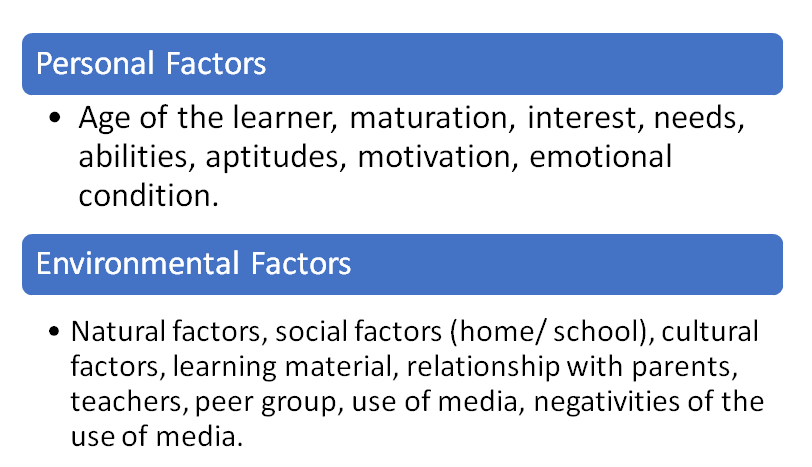
Factors of learning:
Understanding and managing the different influencing conditions
both personally and environmentally is the crucial aspect in the classroom
management.

Operant conditioning theory:
Operant
conditioning (sometimes referred to as instrumental conditioning) is
a method of learning that occurs through rewards and punishments for behaviour.
Through operant conditioning, an association is made between a behaviour and a
consequence of that behaviour.
For example, when a lab rat
presses a green button, he receives a food pellet as a reward, but when he
presses the red button he receives a mild electric shock. As a result, he
learns to press the green button but avoid the red button.

His theory was heavily
influenced by the work of psychologist Edward Thorndike, who had proposed
what he called the law of effect. According to this principle, actions that are followed by
desirable outcomes are more likely to be repeated while those followed by
undesirable outcomes are less likely to be repeated.
Let’s
deal this with two scenarios:
Scene 1-
When a student is praised for her handwriting, the student would try to make it
better and beautiful. Operant conditioning relies on a fairly simple premise
- actions that are followed by reinforcement will be strengthened and more
likely to occur again in the future.
Scene
2- After the teacher asked a question, the students reply all together in a
group. The teacher does not like this behaviour and asks the children to raise
their hands, if they know the answer.
Conversely,
actions that result in punishment or undesirable consequences will be weakened
and less likely to occur again in the future.

Types
of Behaviour by Skinner:

Components of Operant Conditioning Theory:
Let’s learn about the
concepts.
Reinforcement in Operant conditioning theory can be positive
reinforcement or negative reinforcement.
Positive reinforcement: They are favourable
events or outcomes that are presented after the behaviour. Strengthening the
behaviour by the addition of something, could be praise or a direct reward. For
example: Teacher giving a star sticker to a student in the class.
Negative
reinforcement: It involves the removal of an unfavourable event or outcome
after the display of a behaviour. For example: Students are screaming in the
class and the teacher announces that she will give the star sticker to the
students who are disciplined.
In
both of these cases of reinforcement, the behaviour increases.
Punishment in operant conditioning theory can be positive
punishment or negative punishment.
Positive punishment: It is referred to as
punishment by application. It presents an unfavourable event or outcome in
order to weaken the response it follows. For example: Spanking for misbehaviour
is an example of punishment by application.
Negative
punishment: It is known as punishment by removal, occurs when a favourable
event or outcome is removed after a behaviour occurs. For example: Taking away
a child's sticker following misbehaviour is an example of negative punishment.
In
both of these cases of punishment, the behaviour decreases.


Operant
conditioning is something we recognize in our own life on a daily basis,
whether as a parent or a teacher or as an individual.
Social Learning Theory:
Social learning theory is also known as imitation learning
theory or the observational theory. It is a bridge between behaviourist and
cognitive learning theories because it encompasses attention, memory and
motivation. It was developed by educational psychologist Albert Bandura. It is
considered as a highly influential learning theory.
Bandura’s social learning theory points that the people learn
from one another, via observation, imitation and modelling. According to him,
human behaviour is learned observationally through modelling from observing
others, an individual understand the new forms of behaviour; on the later
occasions the learnt code and information serves as a guide for action.
Social learning theory explains human behaviour in terms of
continuous reciprocal interaction between cognitive, behavioural and
environmental influences. The theory identified several factors that determine
whether observing a model will affect behavioural or cognitive change.
These factors include:
1. Learner’s developmental status,
2. The perceived prestige,
3. Competence of the model,
4. The consequences received by the model,
5. The relevance of the model’s behaviours,
6. Consequences to the learner’s goals,
7. The learner’s self efficacy:
Self efficacy is the learner’s belief in his or her ability to perform
like the modelled behaviour. It played an important role in later developments
of the theory.


Observational learning explains the nature of children to learn behaviours
by watching the behaviour of the people around them, and eventually, imitating
them. With the "Bobo Doll" experiment, Bandura included an adult who is tasked to act aggressively
toward a Bobo Doll while the children observe him. Later, Bandura let the
children play inside a room with the Bobo Doll. He affirmed that these children
imitated the aggressive behaviour toward the doll, which they had observed
earlier. After his studies, Bandura was able to determine 3 basic models of observational
learning which included a live model, a verbal instruction model and a symbolic
model. A Live Model, which includes an actual person performing a behaviour. A
Verbal Instruction Model, which involves telling of details and descriptions of
a behaviour. A Symbolic Model, which includes either a real or fictional
character demonstrating the behaviour via movies, books, television, radio,
online media and other media sources.
Bandura believed that learning doesn’t bring change in the
behaviour of an individual. The state of mind is crucial to learning. In this
concept, Bandura stated that not only external reinforcement or factors can
affect learning and behaviour. There is also what he called intrinsic
reinforcement, which is in a form of internal reward or a better feeling after
performing the behaviour (e.g. sense of completion, confidence, satisfaction,
etc.)
Conditions of effective modelling:
The Modelling Process developed by Bandura helps us understand
that not all observed behaviours could be learned effectively, nor learning can
necessarily result to behavioural changes. The following are the steps included
in order for us to determine whether social learning is successful or not:
Attention: Attention to a particular behaviour is the first
step. Various factors such as distinctiveness, affective valence, prevalence,
complexity, functional value increase or decrease the amount of attention paid.
Individual’s characteristics like sensory capacities, arousal level, perceptual
set and past reinforcement affect attention.
Retention: Behaviours caught in the attention of the observer
has to be retained in the memory for it to get absorbed into the system of the
observer. Memory retention is facilitated by symbolic coding, mental images,
cognitive organization, symbolic rehearsal and motor rehearsal.
Reproduction: After attending the information and later
retaining it, this step requires demonstration of the behaviour. Perfection in
reproduction of the behaviour, mannerism can be attained by reproduction of the
observed behaviour.
Motivation: Feeling a sense of motivation. Motivation to repeat
the behaviour is what we need in order to keep on performing it. This is where
reinforcement and punishment come in. For example: We can reward a student
after observing his/her demonstration and proper behaviour, and can punish on
displaying it inappropriately. Having a good reason to imitate includes promised, imagined and
vicarious incentives.
Classical Conditioning Theory:
This theory is also known as Conditioned response theory,
Respondent conditioning theory and Pavlovian conditioning. Conditioning means
modification of a natural response. It is the acquisition of a new
stimulus-response relationship. This theory was developed by a Russian
physiologist Ivan Petrovich Pavlov in 1904. He got the Nobel Prize on his
research ‘Digestive system of dogs’ in the same year.

Pavlov’s Experiment:
Pavlov conducted a number of experiments on dogs to study how
the stimuli and responses are associated.
Classical conditioning is a type of learning, where a neutral
stimulus is paired with a stimulus that elicits an emotional or physiological
response. After repeated pairing, the previously neutral stimulus alone will
elicit a similar response.


Principles of Classical Conditioning:
Let's
take a closer look at five key principles of classical conditioning:
Acquisition:
Acquisition is the initial stage of learning when a response is first
established and gradually strengthened.
During the acquisition phase of classical conditioning, a neutral stimulus is
repeatedly paired with an unconditioned
stimulus. After an association is
made, the subject will begin to emit a behaviour in response to the previously
neutral stimulus, which is now known as a conditioned stimulus. It is at this point that we can say
that the response has been acquired. If we take a look at the experiment, dog
was conditioned to salivate in response to the sound of a bell. Pavlov
repeatedly paired the presentation of food with the sound of the bell. We can
observe that the response was acquired since the dog began to salivate in
hearing the bell sound.
Extinction:
It is when the occurrences of a conditioned response decreases or disappears.
In classical conditioning, this happens when a conditioned stimulus is no
longer paired with an unconditioned stimulus. The unconditioned stimulus (the
smell of food) were no longer paired with the conditioned stimulus (the bell
sound), eventually the conditioned response (salivation) would disappear. This
is known as extinction.

Spontaneous
recovery: Spontaneous recovery is the reappearance of the conditioned
response after a rest period. For example: When the dog was brought back to the
laboratory after some rest, salivation occurred after hearing the bell.
Generalisation:
Stimulus generalization is the tendency for the conditioned stimulus to
evoke similar responses after the response has been conditioned. For example:
The dog responded to almost any sound roughly similar to the ringing of the
bell.
Classical
Conditioning of a Fear Response:
One
of the most famous examples of classical conditioning was John
B. Watson's experiment in which a fear response was
conditioned in a boy known as Little Albert. The child initially showed no
fear of a white rat, but after the rat was paired repeatedly with loud, scary
sounds, the child would cry when the rat was present. The child's fear also
generalized to other fuzzy white objects.
Differentiation:
Discrimination or differentiation is the ability to differentiate between a conditioned
stimulus and other stimuli that have not been paired with an unconditioned
stimulus. For example: If two sounds are sufficiently distinguishable the dog
responded only to one stimulus- the bell.
Educational
Implications:
A. Bad
habits can be broken by de-conditioning. Many fears, phobias and prejudices are
a result of conditioning.
B. Principles
of classical conditioning can be utilized to create good habits in children
such as punctuality, discipline and respecting elders.
C. Repetition
and habit formation is to be strengthened in the process of learning.
D. Establishing
a connection between stimulus and response is an important objective of
education. Classical conditioning theory established the theory that motivation
is basic to learning.
E. Children
should be awarded immediately, when they do well. The delay of awarding causes
no effect.
F. Most
of our learning is based upon conditioning, so teachers should develop the good
reading habits through conditioning.
We live in a generation ahead than in what we have grown.
Children are the future ‘Ambassadors of peace’ and ‘Leaders of the world’. We
live in a world where the food we are eating is different from what we had as kids.
Different conditions of existence are causing different issues in the growth,
development and maturation of the child. Explosion of knowledge, made parents expect
more from the children.
To attend the needs of
the child it’s important that the parents and teachers work as partners rather
than leaving the education as the responsibility of the teachers. Teachers must
be trained properly and must be aware of the strategies. Every child is unique
and different and has different ways and procedures of learning. We need to be
patient about it and use different ways to find out the processes that brings
change in an individual. School management and the curriculum makers must
understand that, it is very important for the child to settle and must understand
that things need time and plan procedures as per the interest of each child on
a multi planned set up. So that all things are covered and teacher gets time to
plan strategies using the learning theories.
Teachers must apply classical conditioning in the class by
creating a positive classroom environment to help students overcome anxiety or
fear. Pairing an anxiety-provoking situation, such as performing in front of a
group, with pleasant surroundings helps the student learn new associations.
Instead of feeling anxious and tense in these situations, the child will learn
to stay relaxed and calm. These theories help a teacher in managing the class
as a whole. Children in general and we as individuals, learn things by
observing models, parents, teachers, peers, motion pictures, TV artists,
bosses, and others. Many patterns of behaviour are learned by watching the behaviours
of others and observing its consequences for them. For effective teaching
teacher should arrange effective contingencies of reinforcement.
Operant conditioning is a behaviour therapy technique that shape
students behaviour. For this teacher should admit positive contingencies like
praise, encouragement etc. for learning. One should not admit negative
contingencies. Example: punishment leading to escape stimulation.
Complex behaviour exists in form of a chain of small behaviour.
Control is required for such kind of behaviour. This extended form of learning
is shaping technique. Teachers and parents should know how to motivate the
children to learn.
As teachers we should be versatile with various strategies that
can enhance effective participation of the students in the teaching-learning
activities. The teachers should be familiar with these theories and apply it to
teaching-learning activities where ever applicable.


A teacher’s job is the most important of all as they play
multiple roles at school and are the architects designing the future of the
nation and world as whole. Parents of today’s world must understand this and appreciate
the work of schools and must work parallelly with the teachers for the holistic
development of a child.


