Wednesday, October 16, 2019

PSYCHOLOGY OF TEACHING AND LEARNING :: INSIGHTFUL LEARNING THEORY AND EDUCATIONAL IMPLICATIONS.

Dear all,
Thank you for all the support and encouragement. I am getting good responses from different parts of the world. I am so overwhelmed that felt to start today’s blog with a heartfelt reply.
 “Thank you for motivating me.”

Today’s blog is about a wonderful learning theory from psychology postulated by…... Wolfgang Kohler, a German Gestalt psychologist.

 In our day to day life we experience the various theories and the ways in which we try to learn things. Insight learning theory is very close to my heart as I believe a lot in the concept of subconscious mind….so let’s go ahead and discuss it in detail!


Max Wertheimer is the father of Gestalt Theory. Later, Wertheimer’s theory was further refined and developed by Kurt Koffka and Wolfgang Kohler. C. V. Good defines gestalt-configuration, total structure, form or shape, a term designating an undivided articulate as a whole that cannot be made by the more addition of independent elements, the nature of each element depending on its relationship to the whole. The term ‘gestalt’ means a whole, a total composition. According to this theory, an individual learns an object, a single entity, not in parts or bits. In other words, an individual’s understanding of an object comprehends the whole object, not merely parts or bits of the object. This theory can be summed up in the succinct statement: ‘The whole is greater than the sum of its parts.’


In the 1920s, German psychologist Wolfgang Kohler studied the behaviour of apes. He designed some simple experiments that led to the development of one of the first cognitive theories of learning, which he called insight learning. It is based upon the concept that whole is meaningful than sum of its parts. Insight in learning occurs in a flash and that involves the solving of a problem.

Kohler’s Experiment:
Kohler (1925) performed set of experiments with a chimpanzee name Sultan inside a cage. In the cage was a bunch of bananas hanging from the roof. A box was kept inside the cage. The chimpanzee tried to get the bananas but was unable to due to his height. Finally, he used the box, climbed on it to reach the bananas.
In another experiment, the chimpanzee required two or three boxes to reach the bananas. He succeeded in reaching the bananas by placing a box on the top of the other.
In another experiment, the banana bunch was kept outside the cage and two sticks were placed in the cage. After several trials the chimpanzee joined the sticks to reach the bananas.


Characteristics:
Insight is the sudden grasping of the solution of the problem.
It depends upon the intellectual ability of the learner.
It is facilitated by the previous experiences.
It involves understanding and reasoning about the problem.

Steps in Insight learning:
Kohler feels these steps are involved in learning-
Identifying the problem: Learner identifies the problems in goal attainment.

Understanding the problem: The learner analyses the situation and the nature of the problem.

Initial Efforts: Efforts in the form of simple trial and error mechanism.

Incubation of Ideas: A period of hesitation or pause from the problematic situation. During this period, mind keeps the task alive.

Insight Development: A flash of lightening comes in mind to solve the problematic situation.

Repetition and Generalisation: After obtaining an insightful solution for the problem the individual applies, this knowledge thus obtained in another situation which require similar type of solution.

Principles Involved in Insightful Learning:
There are principles involved in perceptual organization or insightful learning. Some of the basic laws propounded by Gestalt psychologists are as follows;

Law of figure ground:  This is a type of perceptual grouping which is a vital necessity for recognizing objects through vision. Everything is perceived in the context of its background.  This law examines how the eye can separate shapes in a design from the background of that design. This law is also called law of closure.

Law of pragnanz: An organism is motivated to learn when there is tension or disequilibrium of forces in the psychological field. Learning is the removal of this tension. When we perceive an object, we find some gaps in our perceptions. These gaps are filled by the perceiver and a whole figure is prepared.

Law of continuity: Objects having continuity are learnt easily because they can easily make a whole.

Law of similarity: This law makes the individual to grasp things which are similar. They are picked out as they were from the total context. Similar ideas and experiences get associated. An object revives another object which resembles or looks like it. For example, seeing a man and remembering an intimate friend by some resemblance though never saw them together in the past.

Law of proximity: This law states the proximate or near together things are picked up first and learnt easily than distant things. In other words, perceptual grounds are favoured according to the nearness of their respective parts. Items tend to form groups if they are spaced together. For instance, a triangle or a circle is understood in this way.

Educational Implications:
1. The teacher should present the concept as a whole to facilitate the insight learning.
2. The theory also focuses on the motivational part. Motivation is very important for learning.
3. The theory believes on the fact that understanding is very much essential for solving the problem. The teacher should encourage the students to understand the task.
4. The intellectual capacity of the learners also contributes to the insightful learning.
5. The theory takes into consideration the individual differences in learning.
6. The teacher should develop the reasoning power and capacity to discover new facts rather than spoon feeding and providing bookish knowledge.

7. The theory advocates the child-centered approach to teaching-learning.


Wednesday, September 25, 2019

PSYCHOLOGY OF TEACHING AND LEARNING ::TRIAL AND ERROR THEORY BY THORNDIKE


Trial and error theory are known as connectionism and S-R reinforcement theory. The American Psychologist Thorndike put forth this theory after conducting the experiments with animals.
Thorndike believes, learning is a connection between stimulus and response. It is a bond between S and R. The S-R connection is through trial and error and hence this process is called as Trial and error learning.


Thorndike explained this theory and he arrived at it after several experiments. According to him learning takes place through a process of approximation and correction. A person makes many trials, some responses do not give satisfaction to the individual, but he goes on making further trial till he gets satisfactory response.


Thorndike’s Experiment:

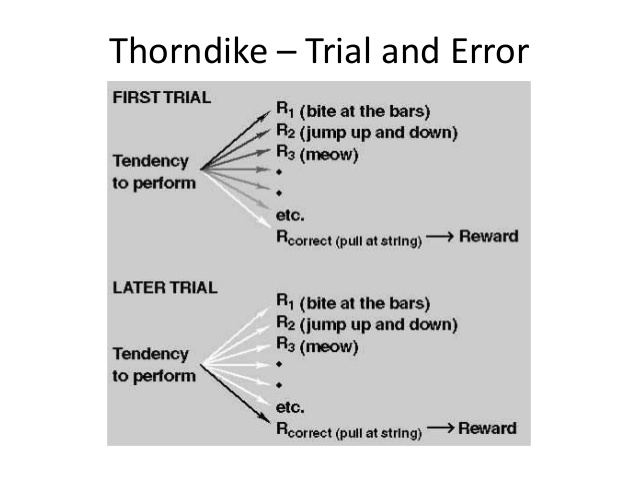
Thorndike performed an experiment with a cat. A hungry cat was kept in a cage. The cage can be opened by pulling a string. Infront of the cat was kept a piece of fish in a plate away from the cage. In order to eat, the cat did number of attempts to pull the strings or say random movements like jumping, hitting, dashing, pushing the bars. In order to reach the goal, the cat makes a number of responses to the situation, i.e. it makes a number of trials. Let the trials be R1, R2, R3, R4, etc. After such trial and errors, the cat succeeded. Every time the cat came out of the cage, it was put inside again. On subsequent trials, the cat took shorter periods of time, committed a smaller number of errors. Finally learning how to escape from the cage.

Features:

With increase in the number of trials, the random movements or activities decrease. Learning by trial and error is gradual. There is learning only if there in a motive (cat hungry). The learner makes random movements. Satisfying response become better learned as they lead to the attainment of goal. So, after several trial and error activities, the learner attains the correct learning.


Thorndike’s Laws of Learning:

Based on his experiment, he postulated three laws:
Law of Readiness: - Readiness is the preparedness of an organism in a certain manner. Readiness depends upon the maturation and experience of the learner.

Law of Exercise: - The law of exercise is known as the law of habit formation. The law implies the strengthening of S-R connection with practice. The effect of learning is improved by continued practice. This law has two sub-laws.


Law of use: - S-R connection is strengthened by practice.
Law of Disuse: - S-R connection weakens without practice.

Law of Effect: - The law explains the importance of effect or consequence in strengthening or weakening of the S-R connection. If the learner is satisfied, he gets stamped in. If not stamped out. Satisfying results strengthen the S-R bond. Thus, this law emphasises on the role of reward and punishment in the process of learning.


Subordinate Laws of Learning:


Law of Multiple Response: -According to it the organism varies or changes its response till an appropriate behaviour is hit upon. Without varying the responses, the correspondence for the solution might never be elicited. In new situation learner response in a variety of ways before arriving at correct response.

Law of Set/ Attitude: - Learning is guided by a total set or attitude of the organism, which determines not only what the person will do but what will satisfy or annoy him. The attitude leads to perform the task well.

Law of Prepotency of Elements: - According to this law, the learner reacts selectively to the important or essential in the situation and neglects the other features or elements which may be irrelevant or non- essential. The ability to deal with the essential or the relevant part of the situation, makes analytical and insightful learning possible. A learner makes sensitive responses in learning situation. 

Law of Response by Analogy: - According to this law, the individual makes use of old experiences or acquisitions while learning a new situation. There is a tendency to utilise common elements in the new situation as existed in a similar past situation. Most of the time new situations are tackled by past experiences.

Law of Associative Shifting: - According to this law we may get a response, of which a learner is capable, associated with any other situation to which he is sensitive. Thorndike illustrated this by the act of teaching a cat to stand up at a command. A fish was dangled before the cat while he said, ‘stand up’. After several trails by presenting the fish after uttering the command ‘stand up’, he later ousted the fish and the overall command of ‘stand up’ was found enough to evoke the response in the cat by standing up or her hind legs. Responses shift by situation.


 Educational Implications of Trial and Error Theory:

Trial and error learning are connected with motor learning. But it has also some implications for abstract thinking. Some of the school subjects that require abstract thinking like science and mathematics, are affected by this process. The pupils must make several unsuccessful attempts before he/she arrives at the desired result.

He/she should, therefore, be trained to make attempts over and over again, and without feeling bored off. Everything related to this process must be taken positively and with parental support so that things are done patiently for higher achievement.

Practice leads a man towards maturity. Practice is the main feature of trial and error method. Practice helps in reducing the errors committed by the child in learning any concept.

Habits are formed as a result of repetition. With the help of this theory the wrong habits of the children can be modified, and the good habits strengthened.

As parents and teachers, we must see to it that the future generation must make a solid slogan of ‘try, try again’ and ‘never to give up’. The children must be taught, it is ok to lose. Winning and losing are the parts of the journey of life. What is important is to live and learn. Life skills these days are very important for the overall growth of the children.

Before I end this month's blog..... 


The time for the celebration of the victory of the good over the evil has arrived. Let's continue the same spirit. 

Happy Dusshera! 

Wednesday, August 21, 2019

PSYCHOLOGY OF TEACHING AND LEARNING ::BRUNER's THEORY OF INSTRUCTION


Learning is a lifelong process, it is an active process and it goes from womb to tomb. Every day in our life we learn something or the other. Experiences and mistakes make us learn better. In our previous blog we have learnt about the various theories in the learning process. Today we will encounter a very important aspect of learning process. I personally have followed it and have got beautiful results with my daughter. We can teach anything and everything to a child; it just depends upon the mode we choose for the process. This Constructivist theory by Bruner is a very important aspect which every teacher and parent must understand and know about for the betterment of their students and children.

Jerome Bruner and Education

Cognitive psychologist Jerome Bruner designed a concept attainment model to lead students learn concepts effectively by organising information. He felt the goal of education should be intellectual development, as opposed to rote memorization of facts. 


Bruner favours extracting the essential principles from a difficult task and apply them in familiar terms in simpler material the child already knows. His work has expanded our sensitivity to how much a child can learn at an early age.

 Bruner believes that the basic intellectual skills should be taught to the students at school, the aim of it being teaching the problem solving than problem finding. One of the goals of education is making people better thinkers. One can’t think in vacuum. So school instructions must be expanded in foundation making. He believed curriculum should foster the development of problem-solving skills through the processes of inquiry and discovery. He also advocated teaching by organizing concepts and learning by discovery.

Bruner believes in thought internalised language and syntactical rules of language rather than logic. He believed that subject matter should be represented in terms of the child's way of viewing the world.

 Cognitive development is conceived more in terms of internalization of technologies from the culture. Language is the most effective technology available.

 He stresses on the fact by more advanced concepts can be taught to the child at much earlier ages. Bruner’s motive is a theory of cognitive development goes hand in hand with the theory of instruction. That curriculum should be designed so that the mastery of skills leads to the mastery of still more powerful ones.

 He points out that the theory is prescriptive (rules for achieving knowledge or skills and provides techniques for measuring or evaluating outcomes). It is also normative (sets goals to be achieved and deals with conditions for meeting them). Finally, he believed culture should shape notions through which people organize their views of themselves and others and the world in which they live. 

Characteristics of Instructions:

I.Predisposition:

Learner’s personal factors like interest, readiness, motivation as well as cultural factors and teacher-student relationship are very much concerned.

 Natural learning is self-rewarding. It is very important to satisfy curiosity and competence since are intrinsic motives. Reciprocity is the final intrinsic motive relative to willingness of an individual to cooperate. 

Proper planning should be there from teachers’ side for the predisposition of learning.


II.Relating knowledge to learner:

Curriculum should be in a way that corresponds to the mode of representation at which students are functioning. It should involve structuring subject matter in three ways:

1. Enactive mode.

2. Iconic mode.

3. Symbolic mode.


A theory of instruction should specify the ways in which a body of knowledge should be structured so that it can be more readily grasped by the learner.

1. Enactive Mode:

It is learning through actions. It is representing ideas through actions. Child defines the events and objects in terms of action. E.g. like learning to ride a bike. It is easier to mime or pretend a situation because these events are more or less, muscle memories. It focuses on process than on the product.

2. Iconic Mode:

It is learning based on representation through visual and perceptual means. A child has a highly concrete imagery. A mental map that permits to follow a route from where we are, to where we are going. The child can select and organise his perception and work with ‘pictures’ which stand for perceptual events.

3. Symbolic Mode:

Children develop abstract images because they are able to translate experience into language and use language as an instrument of thinking. E.g. verbalisation of the procedure of any experiment or phenomenon observed. The most central system of symbolic activity is language. Examples of symbols include maps, plans, roads and designs etc. 

Teacher’s competence lies in how she/he relates knowledge to learners’ cognitive capacities.


III.Sequence:

There are certain orders of representing material and ideas which are more likely to lead students to basic ideas or principles. Instruction involves guiding learners through a series of statements and restatements in a subject or field of knowledge; to enhance learning.

 An optimum sequence is one which progresses from: 


E.g. flowcharts can teach a lot of information than a long list of unrelated material.


IV.Reinforcement:

It refers to knowledge of results and feedback on the effects of one’s action. Instruction should specify the nature and pacing of rewards and punishments in the process of learning and teaching.

Bruner recommends gradual replacement of extrinsic rewards by intrinsic rewards and replacement of immediate rewards by deferred awards. Its usefulness depends on timing, to whom and where it is given or received. 

Bruner attaches more importance to centrality of language in the development of intelligence. He also thinks of cultural experiences as more important in determining and shaping growth.

 Implications on the learning process:

Bruner’s learning theory has direct implications on the teaching practices which include:

1. Instruction must be appropriate to the level of the learners. For example, being aware of the learners’ learning modes (enactive, iconic and symbolic) will help teacher to plan and prepare appropriate materials for instruction. This will help in addressing the difficult aspects.

2. The teachers must revisit material to enhance knowledge. Building on pre-taught ideas to grasp the full formal concept is of paramount importance according to Bruner. Topics connected are learnt quicker and grasped easily by the children due to familiarity.

3. Material must be presented in a sequence giving the learners the opportunity to acquire and construct knowledge, transform and transfer his/her learning.

4. Students should be involved in using their prior experiences and structures to learn new knowledge. Teacher should help students to categorize new information in order to able to see similarities and differences between topics.

5. Teachers should assist learners in building their knowledge.

6. Teachers should provide feedback that is directed towards intrinsic motivation. Grades and competition are not helpful in the learning process. Bruner states that learners must “experience success and failure not as reward and punishment, but as information”. 


Online Classes Guidelines

For students, this time of the year used to be all about the smell of freshly printed books, new classrooms, new bench mates, new school uni...