Tuesday, February 18, 2020

PSYCHOLOGY OF TEACHING AND LEARNING :: LEADERSHIP.


Students are the architects of the future world. Today the time we are investing in our human resource will define our future of tomorrow as a nation, as a world and as a planet.

To give the best to the future generation, we need to inculcate the best of seeds in them. The young generation are like wet cement and so if we show them the worst things, they get set fast. To have a stronger human race, its most important to teach them what is best for them.

In today’s scenario life skills have become an important part of learning. Small children are committing suicide since they are not able to balance their emotions. Life is for once and a lifetime is the time gifted by god to us to explore and prove something back. Small failures are making the people leave their life and families, the death of an individual is the end of many connected to the individual. To make the person understand the importance of life and to provide a better understanding of life and alternatives to solve the problems in a much easier form, we need to teach leadership skills to the children.


It is very important to understand the fact that the teaching staff and the people directly in contact with the children whether the parents or the other family members are equally responsible for this. It is neither the responsibility of parent nor completely of the teacher. The educational institution should maintain a complete transparency about the child and the teachers must maintain a perfect relation with the parents. Things should happen parallelly for the overall development of the child. These days the parents have issues of misunderstanding and emotional imbalances, such parents must understand the effect on the child.

A child learns what is happening around him/her. It is the responsibility of the parents to provide the basic amenities including a proper environment. A worst environment can hinder the growth of the child, after that planning a better school might not help the child. A good school should provide good education with proper set of teachers and qualities of leadership, life skills and empathy.

 Leadership skills are very helpful for students to achieve their dreams and goals. Leadership teaches us, what to learn, what needs to follow, what is important in certain situations and time etc.
For example, if a teacher asked the question from the whole class, but only one student is answering, and he/she doesn’t know is it right or wrong, but he/she answers, that is leadership. That is the confidence of the inside student. And I think, we all must support unique potentials and creativity hidden beneath every person. It’s not good to criticize the creativity and uniqueness of any students. That’s leadership. 

Leadership provides students the ability to win the game. And that mindset enables them to play to win and never quit. 

We have seen cases of criticism and negative reinforcement working wonders for few, but it might not work well in all the cases when compared to leadership traits.  

To handle daily life challenges, we need leadership skills to find opportunities in a difficult situation.   Leadership provides new opportunities to others such as jobs and income opportunities. Leadership is about leading by example. To achieve daily life goals even to-do lists, we all must depend on our leadership skills. Leaders have their own logic; they do not follow the crowd. A child should be able to think out of box in case of any problems. We should teach them that it is good to try than simply giving up.


Leadership is the art of motivating a group of people to act towards achieving a common goal. A leader or a potential leader should have some acceptable qualities. Such qualities are called leadership traits.


Traits of an effective leader:

Now the big question is how to promote leadership qualities in school children?
It is rightly said that ‘Great leaders are made, not born’!

Kouzes and Posner’s research into leadership that was done for the book “The leadership challenge” have featured 5 qualities.
The 5 qualities include:

  1. Honest
  2. Forward-looking
  3. Competent
  4. Inspiring
  5. Intelligent

Inculcating the correct leadership traits and imbibing the same in children requires an exemplary approach by parents and teachers. And it should be hand in hand. Some of the virtues and directives in leaders which can be developed at an early stage of life are:

Integrity:  Integrity is knowing and doing what is right, even when no one is watching. Sharing stories and setting an example by being a role model yourself is the best way to do it. Mind it, the children learn from parents and teachers and to be their role model means to be true first. Later on, judging and blaming a school or the other aspects is not the right way of dealing problems. Teachers and parents should speak constantly with the children about various things, the way you sow the ideology in their growing brains, the same can we reap back from them, in the form of they being the architect of the society, nation and world as a whole.
 Examples: Teachers can share stories with students through folklores, e-books or story books during library sessions where in the concept of integrity can be presented and promoted.

Teachers and parents can also make up own stories that encourage them to always tell the truth no matter what.

It is also very important since by watching in daily life kids mind allows them to appreciate and respect others.

India is a spiritual land, the land with many diversities. We are still united!! We can use many such facts, stories, tales to teach our future which needs our involvement. A child is a long-term project full of life, emotions and love, it depends upon the parent, the social factors, laws of the country, climate conditions etc. how he or she grows? Few things are in our hand and rest we cannot change, things we can change should be our priority.


Courage: Any expression of courage or even the slightest hint of courage displayed by the child should be noticed and praised. Motivation, positive reinforcement and appreciation goes a long way in nurturing virtues or well being and self esteem in young minds.
Examples: Role play, dramatization and story telling can be good tools to teach courage.

Independent and Creative thinking: Conversations and open-ended question asking sessions are helpful in encouraging children to start thinking in an innovative manner and present better solutions. After getting the obvious answers from the child, asking question like why, what, would have happened if, how did you think or feel; encourage them to think creatively. As elders we should always understand the fact that the answers can be right or at times wrong, firstly they should receive appreciation for trying. Secondly encouragement and motivation for thinking out of box or for promoting divergent thinking among the children.

Discipline: Discipline is helping children develop self-control.  In this world of instant self-gratification, it is the ability to wait, to think before acting and to understand potential consequences of their actions. As they grow, they integrate these limits into their own self-discipline.

Children must feel free to share thoughts, problems, they should be given chances to make choices. Being parents or teachers, we should let them do mistakes so that, they can learn what is right and what is the difference between being right and wrong. Always teaching them these are right things, and these are wrong verbally, makes them impatient and brings a feeling of aggressiveness. The anomalies, 'a perfect child' or 'a perfect parent' do not really exist. Scolding your child can hurt him/her beyond comprehension. And, while some children may express their displeasure at being scolded, other may not although they may feel hurt emotionally.

Children are great imitators. For example, if you shout, they will shout back; if you scold them, they will do the same to someone else. Since your children will grow up to emulate your actions, it would be wise to do what you want them to. Learning from mistakes will help them to understand things better and such learning by doing will last longer.

Self-belief and confidence: Inculcating virtues which lead to a higher confidence quotient and development of self-belief help children use their best of abilities and ideas to a greater degree.
Example: This is my personal experience with my 4 years old, she talks about big things and about reaching other planets and solar systems, she desires to be an astronaut. Being an elder, parent or teacher with such children, we must not laugh or take it as a joke. Encourage, praise, discuss on the strength of the child. Positive appreciation of capabilities helps in developing a more confident attitude which says, ‘I can do it’? I keep telling my kids at school and my own daughter ‘never ever give up’.

As parent and teacher its our responsibility to make the child understand his/her own potentialities. The process of talking and involving in the smallest aspect of your child make them feel that they are accepted, and their parents will be with them always to help. The process should continue and should be consistent or the child gets neglected. Beat the iron when its hot, give them shape from childhood and see the results when they keep growing. Do alternate adjustments as parents and teachers and help them reach their goals.

Responsibility: Leadership is all about ownership, even if caught in the wrong form of doing. It also means knowing when you made a mistake and admitting to your mistakes. This responsibility can be encouraged in a child.
Example: A child after making mistakes blames others or gives excuses. As a teacher we must give an opportunity to let him/her know that its ok to make mistakes and encourage them to assume responsibility. Encourage the children to speak always the truth. Appreciate those who admitted the mistakes and a point to be noted here is to even understand whether the child repeats the same mistake again and again. Such trait of the child should be observed and rectified slowly.

Planning: Given a large task to do, a child can get easily overwhelmed. However, by showing a child how to break it into smaller segments and planning each one out, teacher can build their self-confidence and abilities to take up the complex tasks further in life.

Comparative studies of life with such complex issues and the lesson of proper planning and dividing the complexities into smaller chunks, will make the children understand the ways to find alternatives and this will lead to having a strong ambition towards their goals and life as well.


The future generation is being paralyzed and made handicapped by parents with too much of love and spoon feeding. Learning should be by doing, children should enjoy the process of exploring and should feel the pain at times to understand the fact that nothing is so easy in life. They should understand that ‘if there is no pain there is no gain’.

We should not provide everything to them so easily, let it be toys or whatever they ask for. They should understand the simple logic that what my parents want from me? What I should do to achieve that as a gift from them. Anything that we get easily won’t last for long, such over cared children when go out in the society give up faster. They get disappointed soon and feel worthless.

As a gardener trims the branches and checks the weeds growing in the garden, we as parents and teachers need to put a constant check on things.   A child must be pruned of his/her baser instincts and trained in a proper manner in order to make him/her beneficial for the society. If proper and timely attention is not paid to the process of grooming of the youth, it can turn haywire and become unproductive.


Thursday, January 9, 2020

PSYCHOLOGY OF TEACHING AND LEARNING :: Group Dynamics and Methods used in Group Dynamics.


A classroom is an interactive, independent and influencing group. Pupils and the teacher in any class are interdependent and influencing each other. Without the students, the teacher does not have existence in classroom. Likewise, students without the teacher cannot carry on purposeful activity for long. When they are together, they interact and in course of interaction, influence is exerted.

Interaction among the members of the group causes perpetual change in personality and behavior of the members in the group. Thus, Group dynamics means the change of behavior through interaction in the group. Dynamics means the act of changing.

Group dynamics refer to the forces, which operate in group situations. It studies the structure of the group, and other phenomena, that emerge out of group interaction.

Teacher must be aware of the group dynamics, as they spend a lot of time with groups of children. Group dynamics refers to a set of behaviors such as role playing, influencing and performing certain activities. Observation, role play, buzz sessions, feedback of group processes and group decisions are some of the techniques of understanding that enhance the desirable influences and likewise dilute or discourage the negative forces influencing the group, thus promoting the dynamic nature of the group.

Group dynamics comprises all the principles and laws governing the group and improving the functions of the group. It stresses the social and psychological forces within the group.

Methods:

Sociometry- Classroom must remain dynamic and not dormant. Sociometry studies the classroom dynamics. It was devised by Austrian psychologist J.L.Moreno.

It is the study of those aspects of the socio-emotional climate in the classroom having to do with feelings of attraction, rejection or indifferences. Which pupils express toward each other, when faced with situations calling for interaction within classroom.

It is a method of discovering and analyzing patterns of relationship or friendship within a group setting.  It is a method that includes study of social relations in the classroom. It attempts to know how feelings are transmitted among class-members.

It provides clues to the reasons for behavior-problems. It improves human relations.

Society is basically an “attraction-repulsion” system. It involves a test to know the reactions of students among themselves. Within a few weeks each one would know about others. The teacher prepares a open-ended questionnaire, but he/she also keeps the information confidentially from the others. It has some questions which the students have the freedom to choose. Either the students give a positive response or a negative choice. Based on the student reactions the teacher could prepare a socio-matrix. Each card given to student is checked and the choices are entered in the matrix in the form of ‘tallies.’


In a class of 40 students there would be 40 squares horizontally and 40 vertically making a total of 1600 squares, of which 40 squares would be eliminated by drawing a diagonal line from the top left to bottom right square.

Sociogram- A sociogram is a diagrammatic representation of the mutual choice, rejection and indifferences of the people. The socio-matrix could be represented in the form of a diagram, called sociogram.

In order to draw such a diagram, a few rules must be followed--

Rules:

A à B              A likes B.
A ßà B      Reciprocated choice, A like B and B like A.

A ------à B      A dislikes B.
A     Ã   B          A likes B, B dislikes or rejects A.
    ß----


If neither a broken nor a continuous line is drawn towards a student, it must be taken as ‘ignored.’


In order to draw a sociogram for a class consisting of 30 or 40 students, four concentric squares or circles, one within the other are drawn and students are placed based on the positions depending upon their score obtained in the socio-matrix.

Star, Isolate and Rejectee-
In sociometric language, a star is one who has been chosen more often by his classmates. He is the ‘natural’ leader.

An isolate is one who has been ignored by his classmates. It is the duty of the teacher to identify such isolates and help them to mingle with other students.

A rejectee receives maximum number of negative scores. He is disliked by all. He is one who creates nuisance in the class by frequent fighting and quarrelling.

A teacher’s observation and evaluation may not always be right, so it is good to have a sociometric study.

Recapitulation- For more effective learning, students must be allowed to have exchange of ideas freely without much intervention by the teacher. This freedom would make them think and articulate. Communication skill is very important.

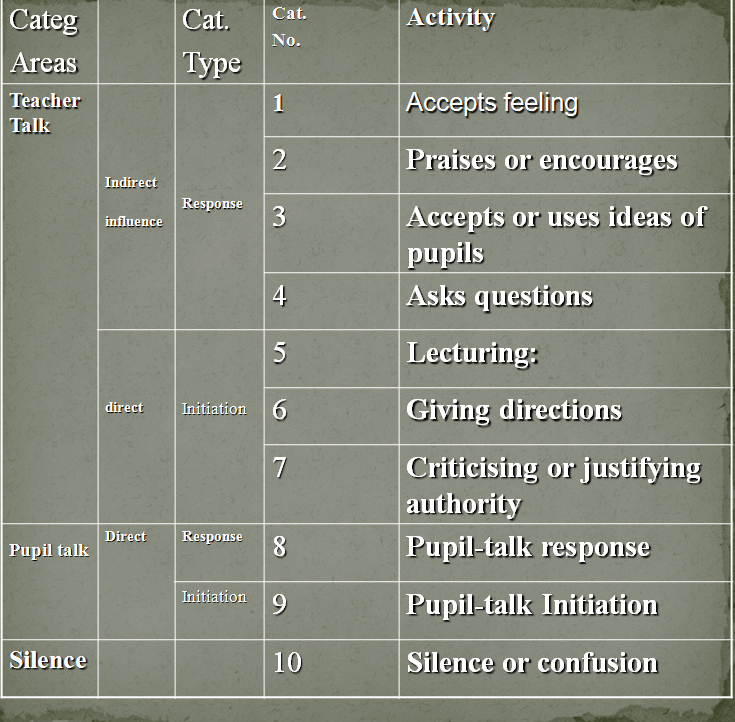
Ned Flander, an American educationist tried to study such pupil-interaction and relate the same to the learning outcome. Such a study is called Interaction Analysis.

Example: - Does the teacher talk all the time in the class, or does the teachers allow students to talk. By his analysis he identified 10 categories of interaction. The student will record the happenings in a sequential order in a matrix.


 After his analysis Flander concluded, Indirect influence being better than the direct influence. 

As a teacher we at times form teams at school, we need to understand the fact that, all teams are groups but not all groups are teams. Teams often are difficult to form because it takes time for pupils to learn how to work together. Belonging to a team, in the broadest sense, is a result of feeling part of something larger than oneself. In a team-oriented environment, one contributes to the overall development of each other. One works with fellow friend to produce better results.

When we understand the group dynamics of a class, a teacher can actually take up the class in his or her hands and mold them perfectly the way he or she wants. The bigger picture drives your actions; your function as teacher exists to serve the bigger picture.

It is the positivity that a teacher includes in a class which then is adopted by the pupils, who ‘work intensely on a specific, common goal using their positive synergy, individual and mutual accountability, and complementary skills’.

Team-building helps to increase intra-group and inter-group effectiveness to bring pupils together, make them share their perception of each other and understand each other’s point of view and make the whole process of learning beneficial for the entire class as a team and hence, our goal of making the ambassadors of peace is attained.

And lastly in the making of Great Leaders we need influencing and inspiring teachers... 

HAPPY NEW YEAR 2020


Tuesday, December 10, 2019

PSYCHOLOGY OF TEACHING AND LEARNING :: VYGOTSKY's CONSTRUCTIVIST THEORY.


Constructivism is a category of learning theories in which stress is laid on the agency and prior knowledge of the learner, and often on the social and cultural determinants of the learning process.

The major theme of Vygotsky’s theoretical framework is that social interaction plays a fundamental role in the development of cognition. Vygotsky states: “Every function in the child’s cultural development appears twice: first, on the social level, and later, on the individual level; first, between people (interpsychological) and then inside the child (intrapsychological). This applies equally to voluntary attention, to logical memory, and to the formation of concepts. All the higher functions originate as actual relationships between individuals.”

The work of Vygotsky and others are together known as Social Development Theory.

Vygotsky’s theories stress the fundamental role of social interaction in the development of cognition, as he believed strongly that community plays a central role in the process of ‘Making Meaning’.

Unlike Piaget’s notion that children’s development must necessarily precede their learning. Vygotsky argued, learning is a necessary and universal aspect of the process of developing culturally organised, specifically human psychological function.

The main principles of Vygotsky’s work:
1. MKO (More Knowledgeable Other)
2. ZPD (Zone of Proximal Development)

MKO indicates someone who has a better understanding or a higher ability level than the learner with respect to a task, process or concept. MKO can be a teacher, an older adult or a child’s peer, who has more knowledge or experience.

ZPD and MKO are related integrally. Taken together they form the basis of the scaffolding component of the cognitive apprenticeship model of instruction.
Another important feature of this theory is scaffolding. When an adult provides support for a child, they will adjust the amount of help they give depending on their progress. For example, a child learning to walk might at first have both their hands held and pulled upwards. As they learn to support their own weight, the mother might hold both their hands loosely. Then she might just hold one hand, then eventually nothing. This progression of different levels of help is scaffolding. It draws parallels from real scaffolding for buildings; it is used as a support for construction of new material (the skill/information to be learnt) and then removed once the building is complete (the skill/information has been learnt).


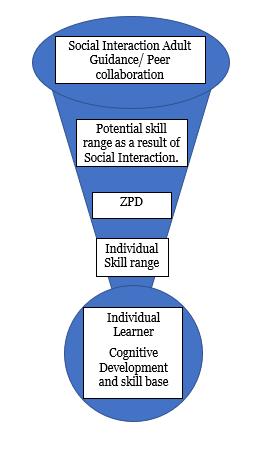
There are two levels of attainment for the ZPD:
Level 1 – the ‘present level of development’. This describes what the child is capable of doing without any help from others.
Level 2 – the ‘potential level of development’. This means what the child could potentially be capable of with help from other people of teachers.

The gap between level 1 and 2 (the present and potential development) is what Vygotsky described as this zone of proximal development. He believed that through help from other, more knowledgeable people, the child can potentially gain knowledge already held by them. However, the knowledge must be appropriate for the child’s level of comprehension. Anything that is too complicated for the child to learn that isn’t in their ZPD cannot be learnt at all until there is a shift in the ZPD. When a child does attain their potential, this shift occurs, and the child can continue learning more complex, higher level material.

Vygotsky (1978) defines the ZPD as the distance between the actual developmental level as determined by independent problem solving and the level of potential development as determined through problem solving under adult guidance or in collaboration with more capable peers. Vygotsky believed that when a student is at the ZPD for a particular task, providing the appropriate assistance(scaffolding) will give the student enough of a “boost” to achieve the task.

Once the student, with the benefit of scaffolding masters the task the scaffolding can be then removed, and the student will then be able to complete the task again on his own.

He believed that language, particularly self-talk and inner speech plays a major role in learning.

Major applications of Vygotsky’s theory to education include:
1 Zone of Proximal Development
2 Scaffolding
3 Guided Participation
4 Apprenticeship
5 Peer Interaction.

Tuesday, November 19, 2019

PSYCHOLOGY OF TEACHING AND LEARNING ::URIE BRONFENBRENNER' s ECOLOGICAL SYSTEMS THEORY.


Urie Bronfenbrenner, Russian-born American psychologist is best known for having developed human ecology theory. The human ecology theory also known as the ecological systems theory, in which individuals are maturing not in isolation. Individuals are developing within the context of relationships, such as those involving families, friends, schools, neighbourhoods, and society.


Bronfenbrenner divided the entire ecological system in which human growth occurs into five subsystems that are organized socially:
1. The microsystem,
2. The mesosystem,
3. The exosystem,
4. The macrosystem, and
5. The chronosystem.


Viewed from the innermost system outwards, Bronfenbrenner’s model illustrates the following systems:

A child lies in the middle of the image. Each circle that surrounds the child is a different layer or environmental system that affects the child's growth and development.

Microsystem — This is the first, and closest, layer of the nested systems which encompasses an individual’s human relationships, interpersonal interactions and most immediate surroundings. Thus, depicting the relationship between an individual child and his/her parents, siblings, and school environment.

Mesosystem — Moving outwards, the second layer surrounding the microsystem encompasses the different interactions between the characters contained within the microsystem. This could include, for instance, the relationships between a child’s family and their schoolteachers. For any interaction to qualify as part of the mesosystem, it must be a direct interaction between two features of the bio-ecological system which influence the development of the individual child.

Exosystem — The third layer is the exosystem which incorporates elements of the bio-ecological systems which do not directly affect the child but may have an indirect influence. For instance, if a parent were to be made redundant or have their working hours reduced, this would then indirectly affect their child in that such events would create parental stress and reduce the family income.

Macrosystem — The outermost, “macro” layer of the bio-ecological model encompasses cultural and societal beliefs, decisions and actions which influence an individual child’s development. This might include, for example, religious influences or parliamentary legislation.

Chronosystem - Lastly is the chronosystem. This system includes major life transitions, environmental events and historical events that occur during development. Moving to another city is one example, as is the first moon landing being televised.

The application of social ecological theories and models focus on several goals: to explain the person-environment interaction, to improve people-environment transactions, to nurture human growth and development environments, and to improve environments so they support expression of individual's system's dispositions.


Urie's work led him to define human development as a lasting change in the way a person perceives and deals with his or her environment. A child is viewed as a growing dynamic entity that progressively moves into and restructures an environment. The environment in turn exerts an influence on the individual, requiring a process of reciprocity between person and environment. 

Urie’s Ecological Systems Theory proposed that human development unfolds in a nested set of systems, involving cultural, social, economic and political elements, not merely psychological ones. These systems and their interactions can nurture or stifle optimal development. Policies and programs can play a major role in shaping these systems – thus potentially promoting human health and well-being. This perspective transformed the study of human development. Among other influences, it encouraged more developmental scientists to examine both naturally occurring and deliberately designed experiments in the real world to illuminate the influences of contexts on human development, and particularly on child development.

Moreover, Bronfenbrenner realized that the developmental process varies by place and time and that public policy affects the development of humans by influencing the conditions of their lives.

With American developmental psychologist Stephen J. Ceci, Bronfenbrenner extended his theory to behaviour genetics. They recommended that explicit measures of the environment in systems terms be incorporated, and they proposed the existence of empirically assessable mechanisms—proximal processes through which genetic potentials for effective psychological functioning are actualized. They hypothesized that when proximal processes are weak, genetically based potentials for effective psychological functioning remain relatively unrealized and, as proximal processes increase in magnitude, potentials become actualized to a progressively greater extent.


Process Person Context Time Model

Urie Bronfenbrenner’s most significant departure from his original theory is the inclusion of processes of human development. Processes, per Bronfenbrenner, explain the connection between some aspect of the context or some aspect of the individual and an outcome of interest. The full, revised theory deals with the interaction among processes, person, context and time, and is labelled the Process–Person–Context–Time model (PPCT). Two interdependent propositions define the properties of the model. Furthermore, contrary to the original model, the Process–Person–Context–Time model is more suitable for scientific investigation.

As per Bronfenbrenner:
"Proposition 1: In its early phase and throughout the life course, human development takes place through processes of progressively more complex reciprocal interactions between an active, evolving biopsychological human organism and the persons, objects and symbols in its immediate environment. To be effective, the interaction must occur on a fairly regular basis over extended periods of time. These forms of interaction in the immediate environment are referred to as proximal processes.

Proposition 2: the form, power and content and direction of the proximal processes effecting development vary systematically as a joint function of the characteristics of the developing person, of the environment-immediate and more remote-in which the processes are taking place and the nature of the developmental outcome under consideration."

Processes: Processes play a crucial role in development. Proximal processes are fundamental to the theory. They constitute the engines of development because it is by engaging in activities and interactions that individuals come to make sense of their world, understand their place in it, and both play their part in changing the prevailing order while fitting into the existing one. 

The nature of proximal processes varies according to aspects of the individual and of the context—both spatially and temporally. As explained in the second of the two central propositions, the social continuities and changes occur overtime through the life course and the historical period during which the person lives. Effects of proximal processes are thus more powerful than those of the environmental contexts in which they occur.


Person: Bronfenbrenner acknowledges here the relevance of biological and genetic aspects of the person. However, he devoted more attention to the personal characteristics that individuals bring with them into any social situation. He divided these characteristics into three types' demand, resource, and force characteristics. 

Demand characteristics are those that act as an immediate stimulus to another person, such as age, gender, skin colour, and physical appearance. These types of characteristics may influence initial interactions because of the expectations formed immediately. Resource characteristics are those that relate partly to mental and emotional resources such as past experiences, skills, and intelligence, and to social and material resources (access to good food, housing, caring parents, and educational opportunities appropriate to the needs of the society). Finally, force characteristics are those that have to do with differences of temperament, motivation, and persistence. 

According to Bronfenbrenner, two children may have equal resource characteristics, but their developmental trajectories will be quite different if one is motivated to succeed and persists in tasks and the other is not motivated and does not persist.

 As such, Bronfenbrenner provided a clearer view of individuals’ roles in changing their context. The change can be relatively passive (a person changes the environment simply by being in it), to more active (the ways in which the person changes the environment are linked to his or her resource characteristics, whether physical, mental, or emotional), to most active (the extent to which the person changes the environment is linked, in part, to the desire and drive to do so, or force characteristics).
The context, or environment, involves four of the five interrelated systems of the original theory: the microsystem, the mesosystem, the exosystem, and the macrosystem.

Time: The final element of the PPCT model is time. Time plays a crucial role in human development. In the same way that both context and individual factors are divided into sub-factors or sub-systems, Bronfenbrenner and Morris wrote about time as constituting micro-time (what is occurring during the course of some specific activity or interaction), meso-time (the extent to which activities and interactions occur with some consistency in the developing person’s environment), and macro-time (the chronosystem). Time and timing are equally important because all aspects of the PPCT model can be thought of in terms of relative constancy and change.


This rightly talks about the concept of what happens in a school, as the teacher is….... so, the child learns. Or, as the parent is……. so, the child adopts. 


In today’s scenario, bringing up a blooming and curious child, where there are several distractions is too difficult.

To reap best we need to work hard as a parent, teacher and as a responsible individual. Providing an individual with a better environment is very important, may not be a strict environment where children are stressed but a healthy one with proper limits. Providing too much freedom is also not very good for a proper development. 

Too much of anything is bad!


The entire cycle of development is connected and so is the universe. Children are the ‘Ambassadors of World Peace.'

Online Classes Guidelines

For students, this time of the year used to be all about the smell of freshly printed books, new classrooms, new bench mates, new school uni...