Wednesday, April 17, 2019

PSYCHOLOGY OF TEACHING AND LEARNING :: FACTORS INFLUENCING IN LEARNING AND TRANSFER OF LEARNING.


We live in a world that is quickly changing and in this world of ours, the need of the hour is a lifelong learning. Learning is very important in today’s scenario because it boosts our confidence. It makes life enjoyable and provides happiness. Life need to be qualitative than quantitative. Hence, it leads to a better quality of life and finally leads to the total personal development. 

Learning is the process of acquiring new, or modifying existing, knowledge, behaviours, skills, values, or preferences. The ability to learn is possessed by humans, animals, and even some machines; there is also evidence for some kind of learning in some plants. 


Learning is not a passive absorption of knowledge but an active process. Some learning is immediate, induced by a single event, but much of the skill and knowledge accumulates from repeated experiences. Repeated experiences make learning really a piece of cake.  The process of learning involve the individuals who are learning a skill; the learners. 

Learning is the outcome of interaction between the learner and the environment, where learning occurs. This interaction effect may bring in qualitative and quantitative changes and developments in the learner. Understanding and managing the different personal and environmental factors influencing in learning process, helps in the better classroom management. Classroom management systems allow teachers to keep their class moving forward and stop disruptions from occurring.


FACTORS INFLUENICING THE LEARNING PROCESS:


Personal & Environmental Factors

Personal Factors:

Age of the learner: We learn from the day we are conceived in the womb of our mother. As a baby also from the moment we are born, we all learn till we grow. This explains the concept that the child is only physically developed with age but has not developed in social skills required for that age, emotional balance and intellectual operations of that age. Children need readiness to learn actively. The moment the readiness is achieved nothing can stop a child from learning, if the process is conducted properly.

Maturation: A child learns any task when it has attained maturity of that specific age. Academics learning involve not only maturation of one structure but many phases of maturation that may occur at different rates. 

Emotional Condition: Emotional and social climate in the home and school either promote or disturb the emotional health and social interests of the child. 

Needs: The learner is also motivated by conscious and unconscious needs and wants. Need stands for a force in the brain region that organizes perception further experiencing, following action.

Interest: Capitalizing on natural interests and cultivating new ones is the mark of a good educational programme. Intrinsic interest must be achieved.

Motivation: According to Mc Dougall, Leaning requires adequate motivation. The major problem of the curriculum maker and the classroom teacher is knowing and understanding the art and science of motivation. 

Abilities: Ability indicates the process of an individual to perform a task. The three important elements in a learning situation are the:

I.                   Learning material.

II.                Response to the learning material and

III.             The process of learning.


Learning process include both acquisition and retention of the learnt material. Higher abilities such as the ability of an individual to apply principles to new situations and to interpret data are retained over a period of time.

Aptitude: Aptitude indicates the power of an individual to learn and perform a task. Ability refers to a current state and aptitude to a future state. Aptitudes are special skills, knowledge and interest. Learners differ in their aptitudes. Educators use aptitude tests to determine pupils are ready to begin a formal learning programme to enhance their potentialities. 


Environmental Factors:

Natural Factors: Atmospheric conditions have a greater effect on learning. High temperature and humidity reduces efficiency. Productivity and creativeness of the pupils in hot regions is much lower than others. Morning time is the best for mastering difficult tasks. Night time is also better for learning. Poor ventilation and light also brings in fatigue. 


Social Factors: It includes home and school factors-

Home Factors: Parents, siblings and other members of the family and their educational background influence the learning process. Healthy diet, rest and stimulating environment with democratic atmosphere helps in positive learning. 

School Factors: School is a place for formal; education and learning outcomes. The school, its building, surrounding, the peer group influence and co-curricular and curricular activities play key role in the development of an individual. 

Cultural Factors: The way of life of people around the learners have influenced directly and indirectly. Learning societies inspire the learners. Child rearing practices, family life dependency, needs, motivational disposition at various stages of age, personality development. Development of values, ultimate aim of life, self-discipline, habits, lifestyle, eating and dressing etc form the culture. 


Learning Process and learning material:
Learning takes time and patience. It is a process — a journey. The learning process in incomplete without proper learning material. The manner of organization of the learning material and its meaningful presentation is very important for successful instruction. The learning material should have:

I.                   Proper language and presentation as per the maturity level of pupil.

II.                Content should be appropriate.

III.             Sequential presentation of the content.

IV.              Inclusion of real life situation and teaching.

V.                 Open the new dimensions of the knowledge.

VI.              Content presented in the form with pictures, figures, illustrations and tables.


Relationship with Parents:
Parental cooperation and encouragement to learners enhances a child’s learning process. Ambitious parents put too much of pressure. Where as critical parents, interfering parents and scolding parents create anxiety. 

Relationship with Teachers:  
Student teacher relationship matters a lot. The factors influencing learning process under this section are-

·         Teacher’s enthusiasm for teaching,

·         Concern for the students,

·         Clarity and variations in teaching,

·         Guidance to the needy,

·         Counselling the problems of the students,

·         Corrections related to academic weaknesses,

·         Constructive suggestions from the teacher,

·         Freedom given to the students.


 Relationship with Peer Group:
Learning atmosphere in a classroom is not only connected with the student and teacher rather is connected with other students of the class as well.  Self learning, proper learning and peer learning in groups apart from teaching can develop and sustain learning spirit. 

Media influence on learning:
Many topics of learning can be explained very well with the use of media. Use of charts, photos, T.V, computer, models, maps etc to help in proper understanding of the concept on the other hand addition to media is detrimental.


Negative Consequences of Media: 
One of the worst consequences is addiction to media itself. We have stopped using our brains and got addicted to network. Spending countless hours on the social sites can divert the focus and attention from a particular task. The increase in rusting minds, leading to decreased output of individuals. Anything in large quantity is not good for our body. Children are getting addicted and are negatively influenced by the bad content of the media. There is no control over the flow of data on net. The children can be greatly affected by these social networking sites if they are allowed to use them. The children are the future of our nation and the world as one. Gradual changes in the life styles of children and going back to the old days of learning and playing is a best option as compared to this present technological life of social media and gadgets.


TRANSFER OF LEARNING: CONCEPT & TYPES


Learning is transferable. If we keenly observe the process, it consists of many phases and experiences, which connect one kind of learning to the other. Learning experience facilitating other kinds of learning. The influence of previous learning on present learning is called as “transfer of learning”. The transfer of learning helps in optimizing the learning process. 
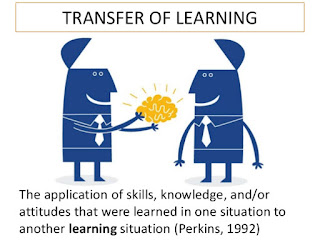


Transfer of learning is defined as the thinking, feeling, habit, knowledge and skill that are carried over from one learning task to another task. When we talk about the transfer of generalization, it is the extension of an idea to a new field. Transfer of learning is a phenomenon, in which positive transfer or negative transfer or both can occur. Positive transfer facilitates learning and negative transfer hinders the learning. It is the influence of previously learned information or task on new situation or tasks.

Based on the influence of the prior learned task on the new task, transfer of learning occur with the following three types-

Positive Transfer: A positive transfer takes place when the previously learned task facilitates the present learning task. For example, the knowledge of addition and subtraction in mathematics facilitates the learning of multiplication and division. The learning of Urdu facilitates learning of Hindi. In case of a child, learning pedalling of tricycle makes the pedalling of bicycle easy.

Negative Transfer: Transfer is negative when learning in one situation hinders, interferes or weakens the learning in another situation. For example, Left hand drive vehicles hindering the learning of right hand drive.

Zero Transfer: When one learning situation does not influence the learning in another situation significantly, it is said to be zero transfer. It is also called as neutral transfer. For example, learning of mathematics has no effect on the learning of swimming.  

THEORIES OF TRANSFER OF LEARNING: 


There are two important theories which explain transfer of learning. These are known as modern theories.

 Theory of identical elements: 

This theory has been developed by E.L.Thorndike. According to him most of transfer occurs from one situation to another in which there are most similar or identical elements.


This theory explains that carrying over from one situation to another is roughly proportional to the degree of resemblance in situation, in other words- more the similarity, more the transfer.

The degree of transfer increases as the similarity of elements increase. For example, learning to ride moped is easy after learning to ride a bicycle. Here, transfer is very fast because of identical elements in both vehicles.

Thorndike was convinced that the method used in guiding a pupil’s learning activities had a great effect upon the degree of transferability of his learning.


Theory of generalization of experience: 

This theory was developed by Charles Judd. Theory of generalization assumes that what is learnt in task ‘A’ transfers to task ‘B’, because in studying ‘A’, the learner develops a general principle which applies in part or completely in both ‘A’ and ‘B’.


Experiences, habits, knowledge gained in one situation help us to the extent to which they can be generalized and applied to another situation.

Generalization consists of perceiving and understanding what is common to a number of situations. The ability of individuals to generalize knowledge varies with the degree of their intelligence.


Saturday, March 30, 2019

PSYCHOLOGY OF TEACHING AND LEARNING ::
Goleman's Theory Of Emotional Intelligence.


The history of emotional intelligence


An IQ test is a psychological measure of a person’s “intelligence quotient” (IQ). For decades, researchers have studied the reasons why a high IQ does not necessarily guarantee success in the classroom or the boardroom. 

By the 1980s, psychologists and biologists, among others, were focusing on the important role other skill sets, which are needed to process emotional information and which are played in promoting worldly success, leadership, ownership, personal fulfillment, healthy and happy relationships.
In 1990, psychologists John Mayer and Peter Salovey of Yale theorized that a unitary intelligence underlay those other skill sets. They coined the term, Emotional Intelligence, to describe a person's ability to understand his/her own emotions. The emotions of others and act appropriately based on these emotions. Thus the skill emotional intelligence, which they broke down into four “branches” as:
1. Identifying emotions on a nonverbal level.

2. Using emotions to guide cognitive thinking.

3. Understanding the information emotions convey and the actions emotions generate.

4. Regulating one’s own emotions, for personal benefit and for the common good.


Later in 1995, Daniel Goleman a journalist, Harvard University professor popularized the term in his book, "Emotional Intelligence: Why it matters more than IQ?" He believes that people with high IQ might not necessarily be successful and a theory that true intelligence is a combination of both IQ and EQ. 

"Daniel Goleman, 1998: Emotional Intelligence refers to the capacity of recognizing our own feelings and those of others for motivating ourselves and for managing emotions well in us and in our relationships."


Importance of Emotional Intelligence:


Emotional Intelligence allows us to think more creatively and use our emotions to solve problems. Daniel Goleman believes EQ to be an important set of psychological abilities that relates to life's success. It is empathy and communication skills as well as social and leadership skills those together acts for the success in life and personal relationships. Rather than IQ, Goleman proposes for high E-IQ, if we want to have a high value in the society.

 Daniel Goleman argues that man particularly need to develop emotional skills and he gives a huge number of examples where people were not successful due to lack of EQ. EQ helps us to have a profound relation with fellow workers, family, friends etc. Those who use EQ are more successful as they persist in the face of setback and channel their emotional energies towards achieving the goals.


The Five Domains of EQ: Goleman's Theory 


As a science reporter for the New York Times, Goleman was exposed to Mayer’s and Salovey’s work and took the concept of emotional intelligence a step further. Goleman broadened Mayer’s and Salovey’s four-branch system to incorporate five essential elements of emotional intelligence or EQ:

1. Emotional self-awareness — knowing what one is feeling at any given time and understanding the impact those moods have on others.

2. Self-regulation — controlling or redirecting one’s emotions; anticipating consequences before acting on impulse.

3. Motivation — utilizing emotional factors to achieve goals, enjoys the learning process and perseveres in the face of obstacles.

4. Empathy — sensing the emotions of others.

5. Social skills — managing relationships, inspiring others and inducing desired responses from them.


Based on the theory the characteristics of high IQ and EQ persons can be distinguished.

If you think emotional intelligence is only important for those who always have to interact or communicate with people, we need to think about it again. Emotional intelligence is a doorway to a balanced-life. 

Physical Health – We live in an extremely bust and stressful life. The ability to take care of our bodies and especially to manage our stress, which has an incredible impact on our overall and total wellness, is heavily connected to our emotional intelligence. Only by being aware of our emotional state and our reactions to stress in our lives can we hope to manage stress and maintain good health.

Mental Well-Being – Emotional intelligence affects our attitude, our behaviour and outlook on life. It can also help to alleviate anxiety and avoid depression and control mood swings. A high level of emotional intelligence directly correlates to a positive attitude and happier outlook on life.
Conflict Resolution – We live in a world where we have started reacting more than understanding. We just want to believe in what we feel is the right and ending up with mere conclusions rather than understanding it thoroughly for more betterment. If we try to present our perception, people just think from their point of view and mistake you for no reason. When we can discern people’s emotions and empathize with their perspective, it’s much easier to resolve conflicts or possibly avoid them before they start. It neither mean we are proving ourselves wrong even thought if we are right, nor it mean we are accepting the other person. We are just trying to calm down the situation and the conflict that might pop up. By using emotional intelligence, we are now better at negotiation due to the very nature of our ability to understand the needs and desires of others. It’s easier to give people what they want if we can perceive what it is. 

Relationships – Relationships are nothing but adjustments. We cannot live together, if we just want ourselves as a priority. By better understanding and managing our emotions, we are better able to communicate our feelings in a more constructive and connective way. We are also better able to understand and relate to others. We can easily connect to people by understanding the needs, feelings, and responses of those we care about and this will lead to stronger and more fulfilling relationships. Minor adjustments in daily life can lead life to wonderful existence.

Success – Success is not a place or a destination. It is being able to go to bed each night with your soul in peace. Life is too short. We need to work by giving priority not to money or luxury rather our existence together on this planet. That is the real success. Higher emotional intelligence helps us to be stronger internal motivators, which can reduce procrastination, increase self-confidence, and improve our ability to focus on a goal. It also allows us to create better networks of support, overcome setbacks, and persevere with a more resilient outlook. Our ability to delay gratification and see the long-term directly affects our ability to succeed.
Leadership – Leadership is not a position, it is working together in a group without expecting position. Leadership is about creating leaders. The ability to understand what motivates others, relate in a positive manner, and to build stronger bonds with others in the workplace inevitably makes those with higher emotional intelligence better leaders. An effective leader can recognize what the needs of his people are, so that those needs can be met in a way that encourages higher performance and workplace satisfaction. An emotionally savvy and intelligent leader is also able to build stronger teams by strategically utilizing the emotional diversity of their team members to benefit the team as a whole. Leadership is victory of thousand of donkeys lead by a lion by defeating thousand of lion lead by a donkey.
Emotional intelligence is still not completely understood, but what we do know is that emotions play a very critical role in the overall quality of our personal and professional lives, more critical even than our actual measure of brain intelligence or the IQ. While tools and technology can help us to learn and master information, nothing can replace our ability to learn, manage, and master our emotions and the emotions of those around us. For bringing the right change in the society, the change must begin from you!!
Life can prosper when we take up the good and learn continuously for betterment. We live in a fast changing life, where we need to adjust with the society. We need to spread ourselves like the roots of a tree, ready to observe water and minerals; ready to grow and prosper. It is very easy to react and cause a conflict, but the fact is in understanding and resolving the situation thereby balancing the energy. The Universal law of energy conservation talks about the fact that energy cannot be created nor can be destroyed rather can be changed into different forms. We can change the reaction by converting it into a better response. It means that we should not hold the energy in us for long rather talk and resolve it for better peace. Everyone around has their own limits and self respect, people tend to be happier when their emotional needs are also met.    


"Emotional intelligence is not something inborn; there are ways to take control of your emotions."

It’s never too late to learn anything, so no matter how old you are, you can still take up EQ and make the rest of your life better and happier.

Observe and understand your feelings.

We easily lose touch with our emotions when we’re too busy worrying about what to do next and what can be done better. Instead of really taking good care of our emotions, we choose to ignore them most of the time. What we don’t realize is that suppressing our emotions only makes things worse. The more we try to put our emotions behind, the more uncontrollable our emotions become.
When we have an emotional reaction to something, it can be due to the fact that we’re having some unsolved issues. So next time when you feel like having some negative emotions, calm down and think about why you’re experiencing this. Take a deep breath and write down the emotions you’re experiencing and the possible reasons.
When you have things written down, you can identify your emotions triggers and think of ways to deal with each of them. Finally as a individual, our happiness is a must.

Practice responding, not reacting.
Reacting is an unconscious process where we behave in an unconscious way that expresses or relieves an emotion. Responding is a conscious process that involves paying attention to your feelings and deciding how to behave.
When you’re more aware of your emotional triggers, you can always think about the way to behave in advance.
For example, if you know that you get angry easily and throw temper to colleagues when you’re feeling very stressful at work, take note of that and think about what you can do next time when you’re experiencing the same trigger. Maybe you can try to tell your colleagues that you need some silent moments because you’re feeling stressful at the moment, or maybe you can get a few minutes of alone time just to calm down yourself first.
At times people understand you from their perception and may think wrong about you. We just need to avoid what people think about you with a smile rather than a reaction. You are a better judge. Train your mind to be calm always and let go the people who think wrong about you. What people think about you is not your problem, today they might say wrong about you but someday they will know the reality. Work upon you for your continuous growth. God falls in love with a stubborn heart who fights continuously with a dedicated heart.


Stay humble all the times.

We were born on this earth. Those who stay connected with mother earth will reach to the best point in life. When you always believe that you’re better than others, you’ll not see your own faults, and you’ll likely to get emotional about things that don’t meet your expectation. Learning is about emptying what you know. We need to be life a sponge, ready to percolate in good things. Until or unless you empty your mind, you won’t be able to be a good learner. Learn from everyone, everything can teach you something. Finally execute the best of learning in your life to achieve your goals.


Try to look at the same thing from a different perspective. Stop judging people, the more you judge them, the more you will increase the gaps. Instead of judging someone or something, put yourself in someone else’s shoes and try to think or feel like them: would you do or feel the same too and why? In this way, you’re likely to understand other people’s thoughts and emotions more; and you’ll probably learn something new about how to deal with stuff in similar situations too. This will prove you to be a better human and a better leader. Anyone can be a leader; it’s not about a position. It is about leading life, it might not give you money or luxury rather it will make you an ethical person in this world. People will get attracted towards you and will like your presence. 

Be humble enough to know you’re not better than anyone, and wise enough to know that you’re different from the rest! Being unique and special and different from others is the need of the hour. Emotional intelligence can be learned, it’s a lifetime process.

It’s never too late to learn anything; it just takes continuous observation and practice. So no matter how old you are, you can still take up EQ and make the rest of your life better and happier. 

Children are the real asset and they are continuously observing us. We need to change the society and the change will happen if we change from in. “Be the change you want to see in others” is the need of the hour. We need to engineer ourselves, if we need the world to change. Be authentic and natural. Take ownership and always keep a back up of what you learnt, during difficult situations. Appreciate even the small things around you. Be your own guide and be a motivator. Children need more of life lessons than the stories from a story book.


Wednesday, February 27, 2019

PSYCHOLOGY OF TEACHING AND LEARNING ::
CREATIVITY.


Creativity Concept


All creative persons transform the ordinary things into something of great charm and beauty. Creativity is the capacity or ability of an individual to create, produce and discover a new idea or object including the rearrangement or reshaping of what is already known. As it involves a process, it is called as creative process. This creative process involves creative thinking i.e., divergent thinking. Creative thinking is always fresh and innovative. Creativity is personal, imaginative thinking which produces a new, novel and useful solution. Unlike ordinary solution to problems, creative solutions are the new one to the effect that other people have not thought before.
Creativity refers to the production of the individual which is new, original, unusual, ingenious and useful to the society. 

This is also a controlled thinking in which the creative thinker whether artist, writer or a scientist is trying to create something new. It involves characteristics of both reasoning and imagination. Creative thinking is a process in which the individual generates an original, unusual and productive solution to a problem.


The product of creative thinking may be a new and unique way of conceptualizing the world around us. The emphasis in creative thinking is on the word ‘new’. In human beings we find two kinds of productive abilities – the convergent and divergent abilities.
Convergent abilities are used to bring together otherwise divergent things. Divergent production abilities are those which are not guided by rules or conventions, but capable of generating new solutions to a problem. Divergent production abilities are particularly important in creative thinking.

The Components of Creativity:

Two of the primary components of creativity are originality and functionality.
Originality: The idea should be something new that is not simply an extension of something else that already exists.
Functionality: The idea needs to actually work or possess some degree of usefulness.


Creativity involves the creative process. The creative process needs creative thinking. Creative thinking is said to involve some specific and definite dimensions or steps or stages. Graham Wallas (1926) has emphasised that creative thinking involves four stages, namely:


Preparation:


Problem solving becomes so easy and familiar with the various features of the problem. In preparation we begin to define, analyse and thus the stage is set for its solution. The plan of action is formulated by means of collecting and analysing the information. In between, if it’s necessary, the plan of action is modified. If there is any failure then we can switch on to other method. At some point, we find that solving the problem is a great problem and we keep it away for the time being. Such a deliberate turning away the issues is the beginning of the second stage- Incubation.

In short, the thinker formulates the problem and collects the facts and materials considered necessary for finding new solutions. Many times the problem cannot be solved even after days, weeks or months of concentrated efforts. Failing to solve the problem, the thinker turns away from it initiating next stage.

Incubation:

In this stage, there is an absence of creative thinking about the problem. We take rest and keep the problem away by being busy with some interesting activities. The problem is allowed to soak in our unconscious mind where the process of finding out a solution for it starts. During this period some of the ideas that were interfering with the solution will tend to fade. The overt activity and sometimes even thinking about the problem is absent in this stage. But the unconscious thought process involved in creative thinking is at work during this period. Apparently the thinker will be busy in other activities like reading literature or playing games, etc. In spite of these activities the contemplation about finding a solution to problem will be going on in the mind.

Meanwhile the new direction may allow the individual in promoting the solution. This leads to the stage of illumination or insight.

Intimation:

 This is one of the sub stages and is considered important. Before moving on to the illumination or insight, the creative person gets a ‘feeling’ that a solution is on its way. 


Illumination or Insight:

In this stage a person comes across a sudden insight or a solution or idea and it proves to be the good solution to the problem. A creative person or thinker gets an insightful solution. Such a change can occur at any point of time in this stage of illumination. The third stage is what most of the public think is a classic signal or sign of a creative person, what is called the insight stage or the insight step. With insight it is really the idea of the ‘Aha’ moment, the ‘Eureka’ moment. Although it is probably the smallest part of the five steps, it is possible one of the most important parts.
This is because your sub consciousness in the previous stages is bubbling away and this insight stage really allows the mind to work on something else. And then bring these ideas to the forefront of your mind. So that’s the third stage, the insight’s or the illumination stage. This leads to the final stage of verification or revision. 

Verification:


This is the final step in the creative process or creative thinking. By this stage illumination is tried out and the solution is revised to or verified to know whether it is effective to solve the problem. Though the solution is found in illumination stage, it is necessary to verify whether that solution is correct or not. Hence in this last stage evaluation of the solution is done. If the solution is not satisfactory the thinker will go back to creative process from the beginning. In order to take these kinds of steps it needs to be analysed and administered.
If it is satisfactory, the same will be accepted and if necessary, minor modifications may also be made to the solution.
Thus, these are the steps of scientific and systematic way of analysing higher creative process.


Types of Creativity:

Experts also tend to distinguish between different types of creativity. The “four c” model of creativity suggests that there are four different types:
  • “Mini-c” creativity involves personally meaningful ideas and insights that are known only to the self.
  • “Little-c” creativity involves mostly everyday thinking and problem-solving. This type of creativity helps people solve everyday problems they face and adapt to changing environments.
  • “Pro-C” creativity takes place among professionals who are skilled and creative in their respective fields. These individuals are creative in their vocation or profession but do not achieve eminence for their works.
  • “Big-C” creativity involves creating works and ideas that are considered great in a particular field. This type of creativity leads to eminence and acclaim and often leads to world-changing creations such as medical innovations, technological advances, and artistic achievements.


What Does It Take to Be Creative?

The Hungarian-American psychologist Csikszentmihalyi, suggests that creative people tend to possess a variety of traits that contribute to their innovative thinking. Some of these key traits include:
1. Energy: Creative people tend to possess a great deal of both physical and mental energy. However, they also tend to spend a great deal of time quietly thinking and reflecting.

2. Intelligence: Intelligence is the quality of being very smart and well-informed. Creativity is the ability to cause or to exist. It is a subjective value. Both, intelligence and creativity are mental abilities. Psychologists have long believed that intelligence plays a critical role in creativity. In Terman’s famous longitudinal study of gifted children, researchers found that while high IQ was necessary for great creativity, not all people with high IQs are creative. Csikszentmihalyi believes that creative people must be smart, but they must be capable of looking at things in fresh, even naive ways.

3. Discipline: Creative people do not just sit around waiting for inspiration to strike. They are playful, yet they are also disciplined in the pursuit of their work and passions.

While some people seem to come by creativity naturally, there are things that can be done to increase own creativity. As Csikszentmihalyi has noted, creativity requires both a fresh perspective combined with discipline. 
As Thomas Edison famously suggested, genius is 1% inspiration and 99% perspiration.
The late American Poet Maya Angelou also suggested that thinking creativity helps foster even greater creativity:
"Creativity or talent, like electricity, is something I don’t understand but something I’m able to harness and use. While electricity remains a mystery, I know I can plug into it and light up a cathedral or a synagogue or an operating room and use it to help save a life. Or I can use it to electrocute someone. Like electricity, creativity makes no judgment. I can use it productively or destructively. The important thing is to use it. You can’t use up creativity. The more you use it, the more you have."


Online Classes Guidelines

For students, this time of the year used to be all about the smell of freshly printed books, new classrooms, new bench mates, new school uni...